Kahapon Muli Bukas

Imelda Cajipe Endaya
Silverlens, Manila

About


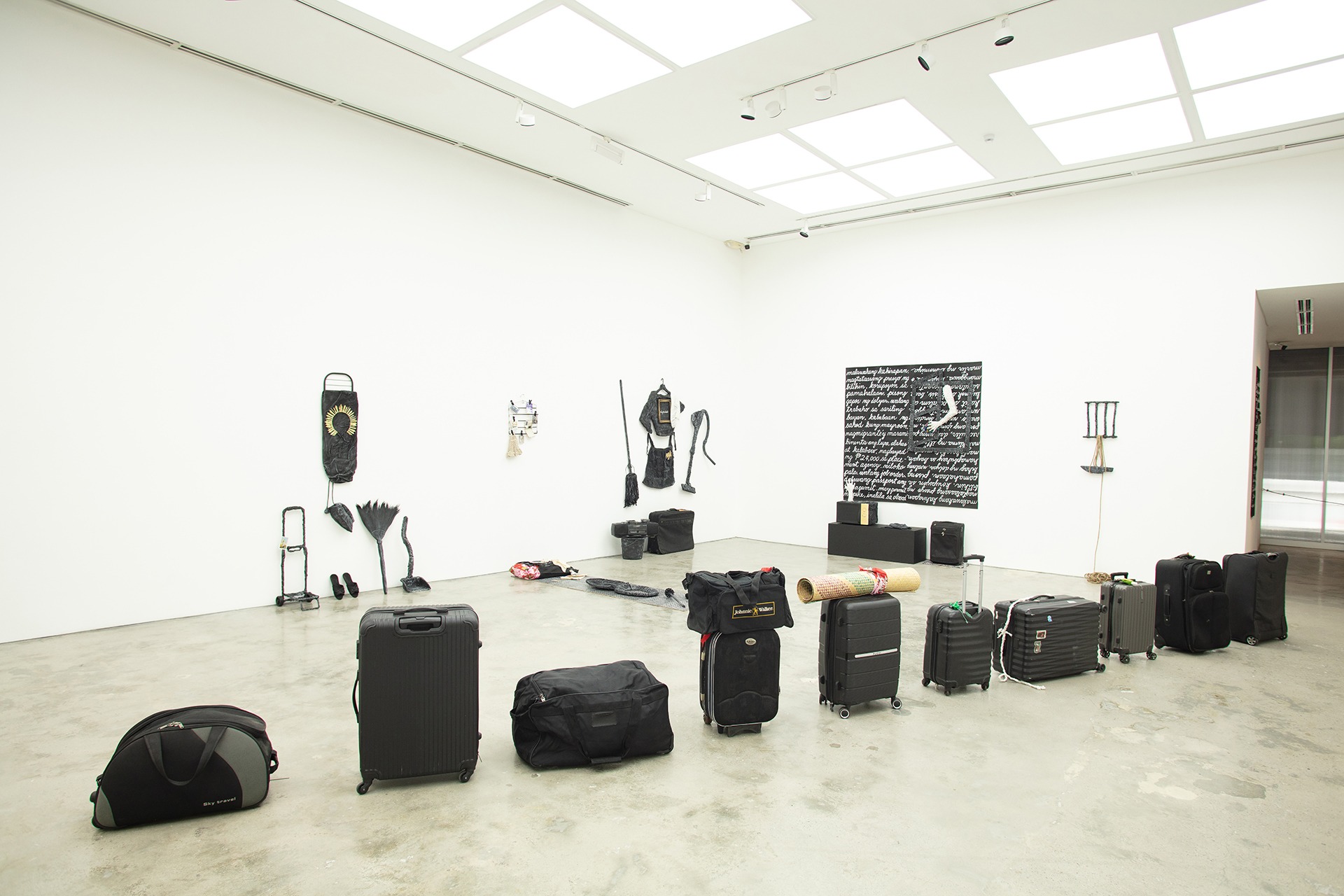
    Battered suitcases. An ironing board adorned with the ray of the Sorrowful Mother. A crumpled blouse inscribed with the word “dignidad”. These are some of the objects that compose the installation Filipina DH by Imelda Cajipe Endaya. First exhibited at the National Commission for Culture and the Arts (NCCA) Gallery in 1995, the work evoked the brutal conditions that Filipina migrant domestic workers faced at the time: women who lacked legal protections abroad and became vulnerable to exploitation; women who carried the emotional weight of raising their children from a distance; women who were often treated as invisible—except for when their most sensational stories rocked the media. In the same year that Endaya showcased Filipina DH, Flor Contemplacion was executed in Singapore, and Sarah Balabagan was convicted of killing her employer who attempted to rape her.


    In the late 1990s, as part of the exhibition Contemporary Art in Asia: Traditions/Tensions organized by the Asia Society, the work traveled from New York to Vancouver to Mumbai to Perth. It makes its homecoming for Endaya’s second solo show at Silverlens Manila, Kahapon Muli Bukas. After roughly 30 years, Filipinos are finally seeing it again—its absence and return a mirror to the stories of the women it honors. 


    For the current iteration of Filipina DH, members of KASIBULAN, a collective of women artists that Endaya co-founded in the late 1980s, lent their used luggage, which forms a diagonal line at the center of the exhibition space. Some of these women were migrant workers themselves, or have family members who were. Reproductions of migrant domestic workers’ personal objects—letter envelopes, Catholic paraphernalia, a broom—surround the luggage. Endaya arranges these belongings in a way that highlights their “ordinariness and intimacy,” echoing their set-ups in everyday homes. How materials weathered from one’s labor sit next to devotional objects; how souvenirs from foreign lands meld with family mementos that make one long for home. 


    A tapestry of white aprons hangs on one wall, where images of migrant domestic workers are projected. In some images, they appear outside their place of work: enjoying a summer in France, posing next to a snowman. Yet, their faces are obscured by an overlaid square. They remain anonymous. Endaya thus maintains a sense of respect for their privacy, while simultaneously evoking their erasure. The vividness of the objects on display also emphasizes the haunting absence of their owners. Academic Louise Anne Salas describes this as an absence that “harbors a sense of estrangement”, giving form to “what one leaves behind in order to seek fortune elsewhere for the future and well-being of loved ones”.¹ This absence compels audiences to ask: Where are these women now? How are their children, who also bore the brunt of their sacrifice? Have the families whose sufferings became public spectacle ever seen justice? 


    As it recalls the migrant domestic workers of the 1990s, the current Filipina DH resists a kind of nostalgia for the era. Rather, it illuminates the enduring precarity of these workers’ conditions—an experience that KASIBULAN artist and former migrant worker Yllang Montenegro describes as “round and round, like a whirlwind”. Remittances from Overseas Filipino Workers (OFWs)—many of whom are women employed in domestic work—have grown dramatically over the last 30 years. Government officials and financial institutions hail this as economic progress. But what is the cost of labor export being a pillar of the country’s economy? Stories of family separation, grueling overwork, and abuse are no longer isolated tragedies. This brings up a central question in discussions about these global economies of care: care by whom, and for whom, and until when? 


    In the 1995 NCCA exhibit, Endaya asked visitors to write down prayers for these women or letters addressed to them, then tie them as tags to the suitcases. Visitors who wrote messages ranged from students, teachers, migrant workers’ relatives, the senate president, to the first lady.² Because how can such an issue be addressed without an urgent, collective plea? Nevertheless, Endaya has always understood the limits of art’s capacity to spark social change. “While our art cannot directly solve this phenomenal national problem, helping provide a vision can certainly spur a positive inspiration,” wrote the artist in 1995, “or an outrage.” She, together with other artists, also fought for the cause beyond their art—advocating for the passage of the Migrant Workers and Overseas Filipinos Act of 1995.


    Kahapon Muli Bukas situates Filipina DH alongside Endaya’s more recent mixed media works, which tackle issues ranging from the struggle against religious oppression to the catastrophic effects of climate change in the Philippines. Here, Endaya centers Filipino women within the country’s vast history, refusing their erasure. These women act. They labor. They fight, guide, heal. They hope. The migrant domestic workers of Filipina DH stand on the shoulders of these women.


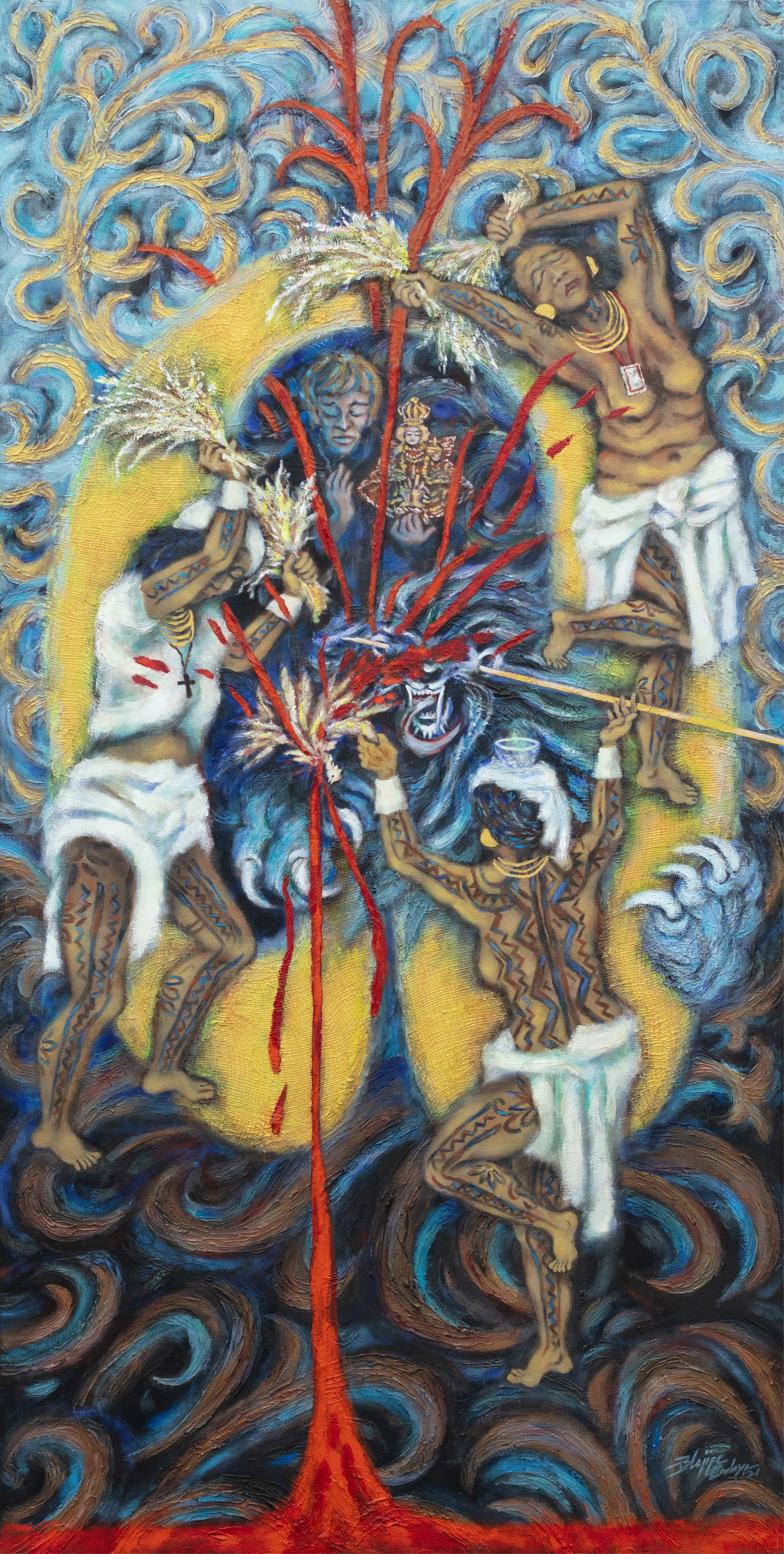
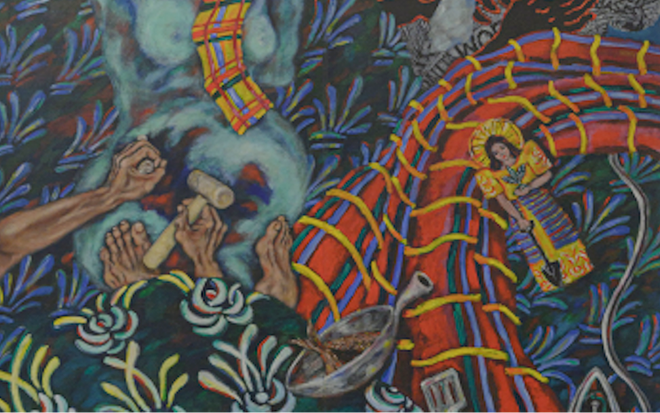
    In Padugo 1521, three tattooed women, including a grandmother and a trans woman, welcome the arrival of the Santo Niño, while simultaneously performing an indigenous blood sacrifice to, in the artist’s words, “exorcise the abusive powers of church-and-state empire” of the Spanish colonial rule. The work captures the tension of Filipino women striving to both embrace the Catholic faith and resist the violence of those who brought it. A tension still felt today, as seen in the religious iconography of Filipina DH—which may indeed reveal the devotion of its owners, but at the same time evoke the culture of abusive employers who wore the cloak of piety.


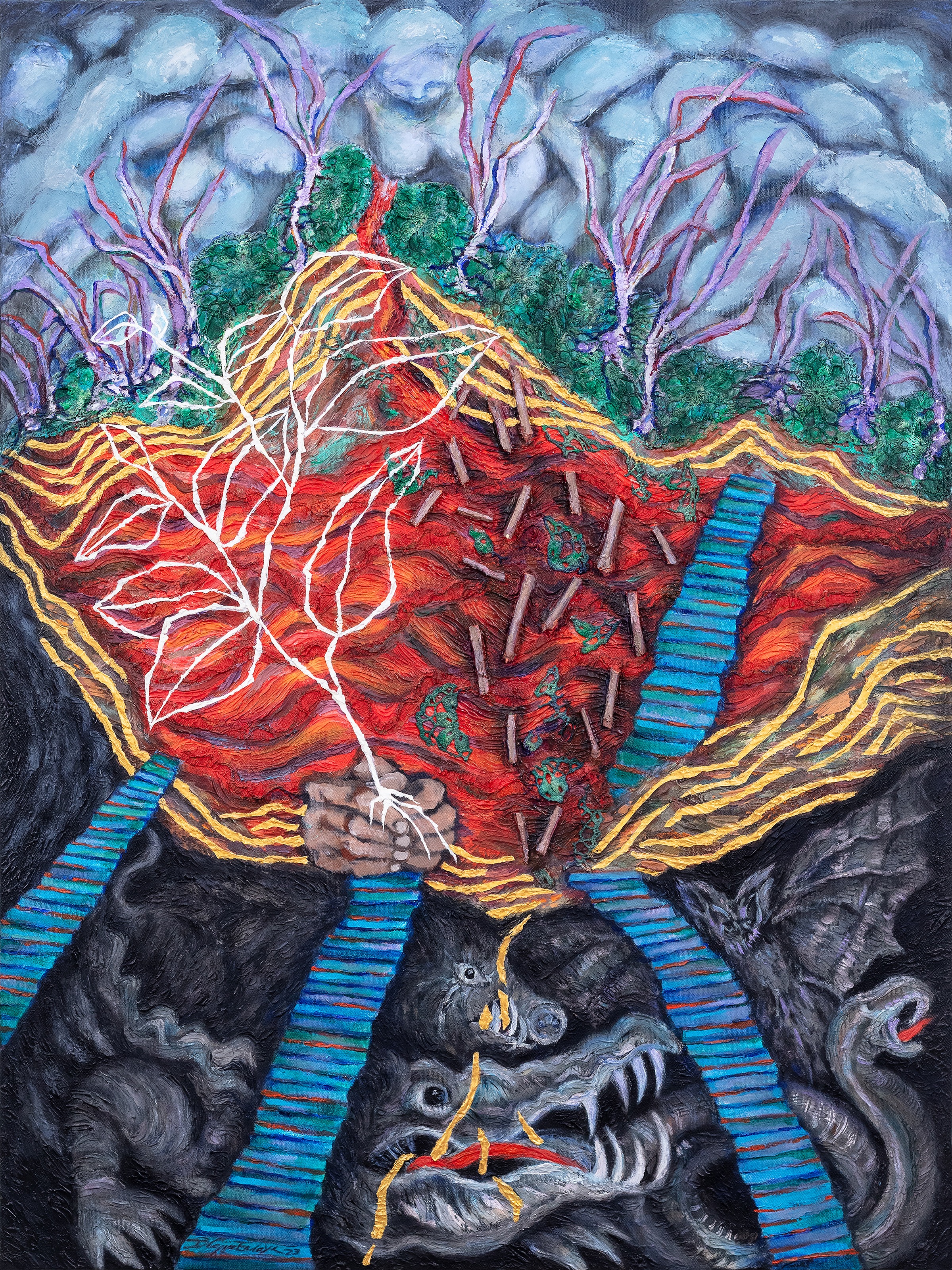
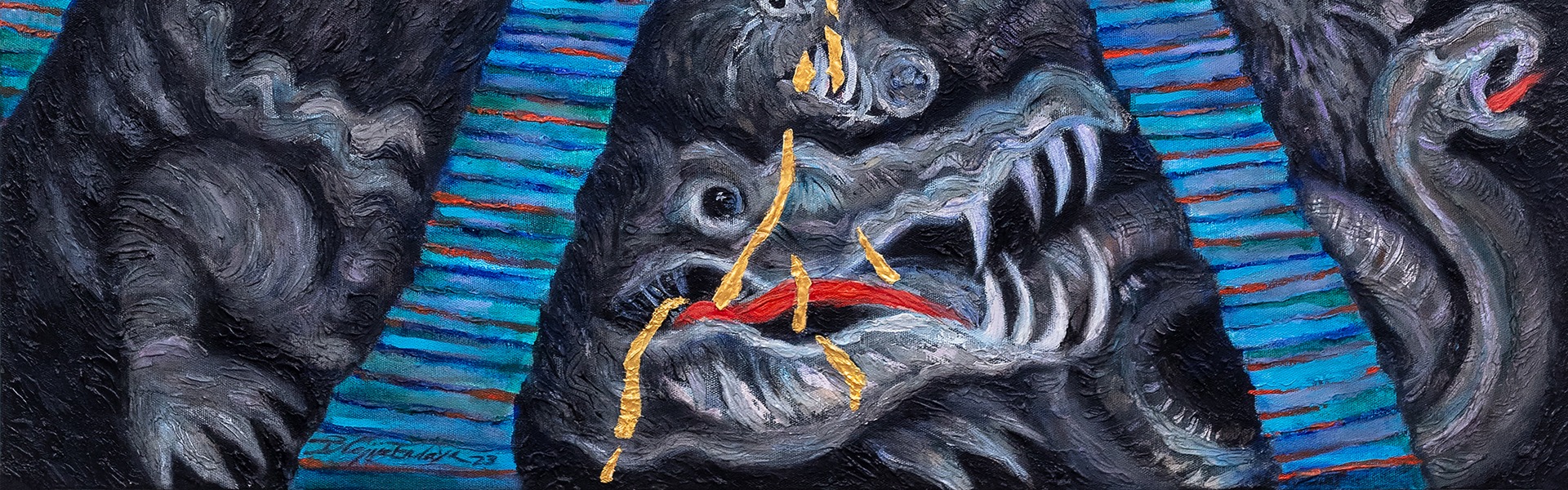
    In Delubyo, Endaya protests the deforestation of the Sierra Madre—a mountain known to shield millions of people living in Luzon from the harshest typhoons; a mountain some describe as their mother. Amid a scene of eroding trees, and monsters symbolizing the greed of those responsible for it, a figure appears in the sky above. It’s easy to miss her, as her form melds with the clouds. Yet, she appears like a celestial being, whose role, though invisible, is vital to protecting nature from further harm.


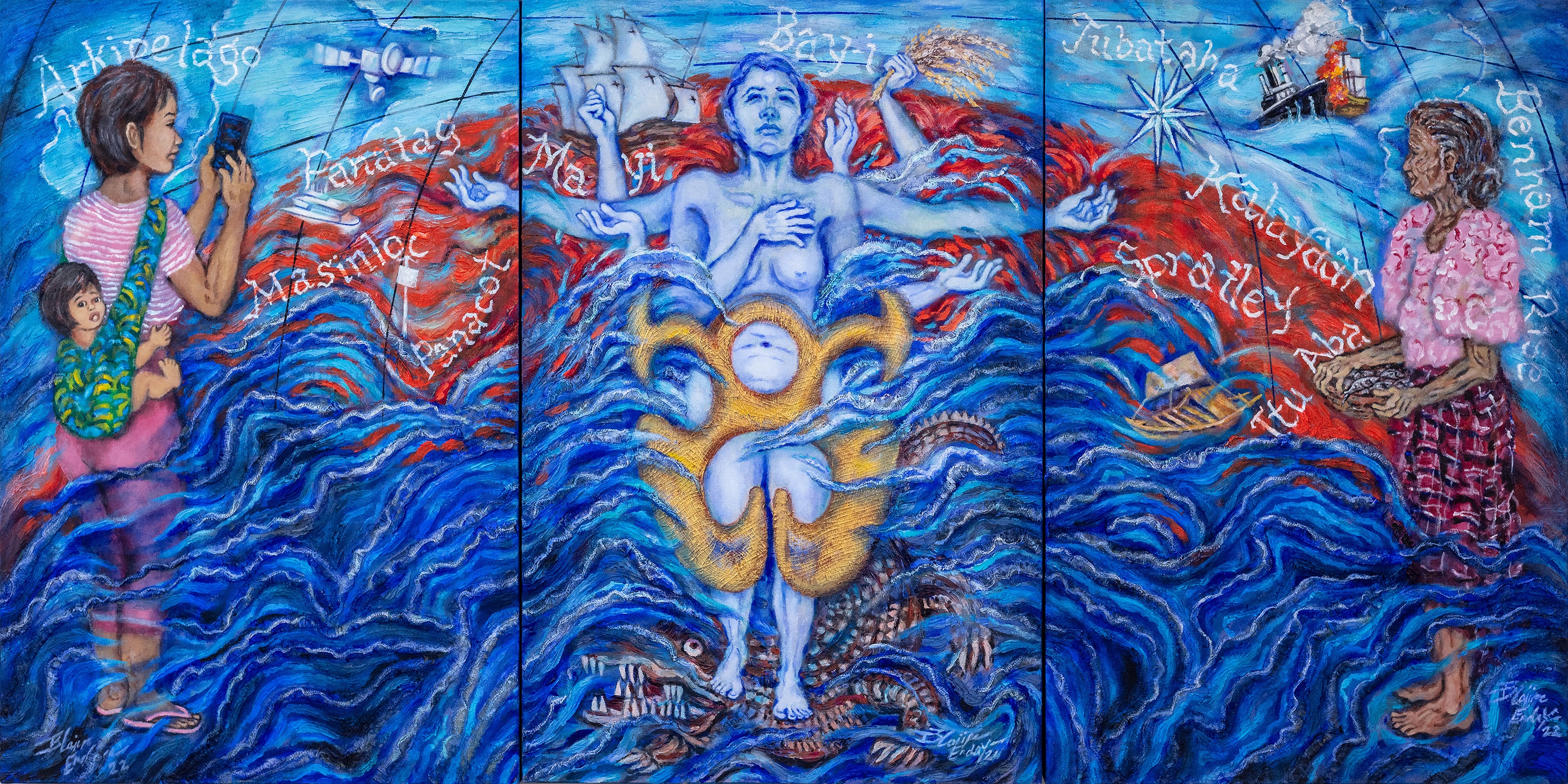
    In the triptych Bay-i sa Ikalimang Dantaon, a nude, indigenous woman stands amidst a tumultuous sea. She possesses many arms and crushes a monstrous creature with her feet, conjuring sacred figures such as the Virgin Mary or the Goddess Durga. The lingling-o, the precolonial symbol of fertility, floats before her. To her left, a grandmother dons a traditional baro’t saya; to her right, a mother holds up a phone—as if snapping a picture of the ethereal woman. Symbols across the background similarly collapse centuries in one plane: a galleon, a satellite, the evolving names of disputed islands and shoals in the West Philippine Sea. The scene would feel entirely surreal, if not for one figure. Clinging to the back of the mother, a young child turns her gaze towards the viewer. Her uncertain, frightened eyes pierce through reality. It becomes impossible to look away—to ignore her future in such a volatile world.


    Endaya describes this work as a kind of self-portrait, even if none of the figures resemble her. She has perhaps always seen herself in each of these women, which speaks to the empathy that radiates in her work. In Kahapon Muli Bukas, she asks us to do the same: every worn object, unsettling gaze, and victorious posture moves us to close the distance between ourselves and the neglected Filipino women of yesterday, today, and tomorrow.

    Words by Nicole Soriano


    ¹Louise Anne Sala, “Encircling Movements: Filipina Visual Artists and Kasibulan, 1970-2000,” Humanities Diliman: A Journal on Philippine Humanities, University of the Philippines Diliman, 2024, p.52.
    ²Lara Acuin, “A Rope, A Chain, A Knife: First Cuts for Filipina DH,” Pelikula: A Journal of Philippine Cinema and Moving Image, University of the Philippines Film Institute, 2022, p. 93.

    Imelda Cajipe Endaya’s (b. 1949, Manila, Philippines; lives and works in Manila, Philippines) artistic career has been devoted to contemporary social issues from the viewpoint of women empowerment. In her art, she has dealt with issues such as cultural identity, human rights, migration, family, reproductive health, globalization, children’s rights, environment, and peace. Her mixed media paintings and installations are richly colored and textured with crochet, laces, textiles, window, flatiron, suitcases, papier mache craft, and found objects from home and popular culture. In so doing she developed a visual language that is distinctly womanly and Filipino.

    Endaya is also a writer, curator, and art projects organizer. She co-founded KASIBULAN, a collective of women artists, and Pananaw: Philippine Journal of Visual Arts, an initiative in contemporary art discourse. She was affiliated with the Philippine Association of Printmakers from 1970 to 1976 and the National Commission for Culture and the Arts Committee on Visual Arts from 1995 to 2001.

    Endaya’s works are in the collection of Bangko Sentral ng Pilipinas, Cultural Center of the Philippines, Philippine National Art Gallery, National Gallery of Singapore, Metropolitan Museum Manila, Okinawa Prefectural Museum, and Fukuoka Asian Art Museum. Among her awards are Ani ng Dangal from the National Commission for Culture and the Arts in 2009, Republic of the Philippines CCP Centennial Honors in 1999, Araw ng Maynila Award in 1998, and the CCP Thirteen Artists Award in 1991. An art educator in the non-formal set-up, she conducts lectures and art workshops.

Battered suitcases. An ironing board adorned with the ray of the Sorrowful Mother. A crumpled blouse inscribed with the word “dignidad”. These are some of the objects that compose the installation Filipina DH by Imelda Cajipe Endaya. First exhibited at the National Commission for Culture and the Arts (NCCA) Gallery in 1995, the work evoked the brutal conditions that Filipina migrant domestic workers faced at the time: women who lacked legal protections abroad and became vulnerable to exploitation; women who carried the emotional weight of raising their children from a distance; women who were often treated as invisible—except for when their most sensational stories rocked the media. In the same year that Endaya showcased Filipina DH, Flor Contemplacion was executed in Singapore, and Sarah Balabagan was convicted of killing her employer who attempted to rape her.


In the late 1990s, as part of the exhibition Contemporary Art in Asia: Traditions/Tensions organized by the Asia Society, the work traveled from New York to Vancouver to Mumbai to Perth. It makes its homecoming for Endaya’s second solo show at Silverlens Manila, Kahapon Muli Bukas. After roughly 30 years, Filipinos are finally seeing it again—its absence and return a mirror to the stories of the women it honors. 


For the current iteration of Filipina DH, members of KASIBULAN, a collective of women artists that Endaya co-founded in the late 1980s, lent their used luggage, which forms a diagonal line at the center of the exhibition space. Some of these women were migrant workers themselves, or have family members who were. Reproductions of migrant domestic workers’ personal objects—letter envelopes, Catholic paraphernalia, a broom—surround the luggage. Endaya arranges these belongings in a way that highlights their “ordinariness and intimacy,” echoing their set-ups in everyday homes. How materials weathered from one’s labor sit next to devotional objects; how souvenirs from foreign lands meld with family mementos that make one long for home. 


A tapestry of white aprons hangs on one wall, where images of migrant domestic workers are projected. In some images, they appear outside their place of work: enjoying a summer in France, posing next to a snowman. Yet, their faces are obscured by an overlaid square. They remain anonymous. Endaya thus maintains a sense of respect for their privacy, while simultaneously evoking their erasure. The vividness of the objects on display also emphasizes the haunting absence of their owners. Academic Louise Anne Salas describes this as an absence that “harbors a sense of estrangement”, giving form to “what one leaves behind in order to seek fortune elsewhere for the future and well-being of loved ones”.¹ This absence compels audiences to ask: Where are these women now? How are their children, who also bore the brunt of their sacrifice? Have the families whose sufferings became public spectacle ever seen justice? 


As it recalls the migrant domestic workers of the 1990s, the current Filipina DH resists a kind of nostalgia for the era. Rather, it illuminates the enduring precarity of these workers’ conditions—an experience that KASIBULAN artist and former migrant worker Yllang Montenegro describes as “round and round, like a whirlwind”. Remittances from Overseas Filipino Workers (OFWs)—many of whom are women employed in domestic work—have grown dramatically over the last 30 years. Government officials and financial institutions hail this as economic progress. But what is the cost of labor export being a pillar of the country’s economy? Stories of family separation, grueling overwork, and abuse are no longer isolated tragedies. This brings up a central question in discussions about these global economies of care: care by whom, and for whom, and until when? 


In the 1995 NCCA exhibit, Endaya asked visitors to write down prayers for these women or letters addressed to them, then tie them as tags to the suitcases. Visitors who wrote messages ranged from students, teachers, migrant workers’ relatives, the senate president, to the first lady.² Because how can such an issue be addressed without an urgent, collective plea? Nevertheless, Endaya has always understood the limits of art’s capacity to spark social change. “While our art cannot directly solve this phenomenal national problem, helping provide a vision can certainly spur a positive inspiration,” wrote the artist in 1995, “or an outrage.” She, together with other artists, also fought for the cause beyond their art—advocating for the passage of the Migrant Workers and Overseas Filipinos Act of 1995.


Kahapon Muli Bukas situates Filipina DH alongside Endaya’s more recent mixed media works, which tackle issues ranging from the struggle against religious oppression to the catastrophic effects of climate change in the Philippines. Here, Endaya centers Filipino women within the country’s vast history, refusing their erasure. These women act. They labor. They fight, guide, heal. They hope. The migrant domestic workers of Filipina DH stand on the shoulders of these women.


In Padugo 1521, three tattooed women, including a grandmother and a trans woman, welcome the arrival of the Santo Niño, while simultaneously performing an indigenous blood sacrifice to, in the artist’s words, “exorcise the abusive powers of church-and-state empire” of the Spanish colonial rule. The work captures the tension of Filipino women striving to both embrace the Catholic faith and resist the violence of those who brought it. A tension still felt today, as seen in the religious iconography of Filipina DH—which may indeed reveal the devotion of its owners, but at the same time evoke the culture of abusive employers who wore the cloak of piety.


In Delubyo, Endaya protests the deforestation of the Sierra Madre—a mountain known to shield millions of people living in Luzon from the harshest typhoons; a mountain some describe as their mother. Amid a scene of eroding trees, and monsters symbolizing the greed of those responsible for it, a figure appears in the sky above. It’s easy to miss her, as her form melds with the clouds. Yet, she appears like a celestial being, whose role, though invisible, is vital to protecting nature from further harm.


In the triptych Bay-i sa Ikalimang Dantaon, a nude, indigenous woman stands amidst a tumultuous sea. She possesses many arms and crushes a monstrous creature with her feet, conjuring sacred figures such as the Virgin Mary or the Goddess Durga. The lingling-o, the precolonial symbol of fertility, floats before her. To her left, a grandmother dons a traditional baro’t saya; to her right, a mother holds up a phone—as if snapping a picture of the ethereal woman. Symbols across the background similarly collapse centuries in one plane: a galleon, a satellite, the evolving names of disputed islands and shoals in the West Philippine Sea. The scene would feel entirely surreal, if not for one figure. Clinging to the back of the mother, a young child turns her gaze towards the viewer. Her uncertain, frightened eyes pierce through reality. It becomes impossible to look away—to ignore her future in such a volatile world.


Endaya describes this work as a kind of self-portrait, even if none of the figures resemble her. She has perhaps always seen herself in each of these women, which speaks to the empathy that radiates in her work. In Kahapon Muli Bukas, she asks us to do the same: every worn object, unsettling gaze, and victorious posture moves us to close the distance between ourselves and the neglected Filipino women of yesterday, today, and tomorrow.

Words by Nicole Soriano


¹Louise Anne Sala, “Encircling Movements: Filipina Visual Artists and Kasibulan, 1970-2000,” Humanities Diliman: A Journal on Philippine Humanities, University of the Philippines Diliman, 2024, p.52.
²Lara Acuin, “A Rope, A Chain, A Knife: First Cuts for Filipina DH,” Pelikula: A Journal of Philippine Cinema and Moving Image, University of the Philippines Film Institute, 2022, p. 93.

Imelda Cajipe Endaya’s (b. 1949, Manila, Philippines; lives and works in Manila, Philippines) artistic career has been devoted to contemporary social issues from the viewpoint of women empowerment. In her art, she has dealt with issues such as cultural identity, human rights, migration, family, reproductive health, globalization, children’s rights, environment, and peace. Her mixed media paintings and installations are richly colored and textured with crochet, laces, textiles, window, flatiron, suitcases, papier mache craft, and found objects from home and popular culture. In so doing she developed a visual language that is distinctly womanly and Filipino.

Endaya is also a writer, curator, and art projects organizer. She co-founded KASIBULAN, a collective of women artists, and Pananaw: Philippine Journal of Visual Arts, an initiative in contemporary art discourse. She was affiliated with the Philippine Association of Printmakers from 1970 to 1976 and the National Commission for Culture and the Arts Committee on Visual Arts from 1995 to 2001.

Endaya’s works are in the collection of Bangko Sentral ng Pilipinas, Cultural Center of the Philippines, Philippine National Art Gallery, National Gallery of Singapore, Metropolitan Museum Manila, Okinawa Prefectural Museum, and Fukuoka Asian Art Museum. Among her awards are Ani ng Dangal from the National Commission for Culture and the Arts in 2009, Republic of the Philippines CCP Centennial Honors in 1999, Araw ng Maynila Award in 1998, and the CCP Thirteen Artists Award in 1991. An art educator in the non-formal set-up, she conducts lectures and art workshops.

Installation Views

Works
Imelda Cajipe Endaya
Filipina: DH
1995
16670
2
Installation of colorful floor mat, tote bag, clothes hanger, clothes pins, painted mittens, cassette tapes, plasterbonded microwave oven, plasterbonded hand, styrofoam dish, painted apron, plasterbonded vacuum cleaner, pail, black radio, mop, plasterbonded iron board, saint's ray made of painted tin, plasterbonded flatiron, painted slippers, painted broom, plasterbonded dust pan, plasterbonded cart, plasterbonded prison bars, abaca rope, plasterbonded knife, black coat, and nine installation work: (1) “Filipina DH: Baggages on parade” (2) “Filipina DH: Job Order” (3) “Filipina DH: Blouse of Dignity” (4) “Filipina DH: Turn House to Home” (5) “Filipina DH: Home, an Ocean Away from Home” (6) “Filipina DH: Mementos” (7) “Filipina DH: Yaya and Child” (8) Filipina DH: Flor Contemplacion (9) Filipina DH: Isolation
Variable dimension
-1
0.00
PHP
0
Details
Imelda Cajipe Endaya
Blouse of Dignity
1995
16666
2
found objects on plaster-bonded textile
31.10h x 36.61w x 4.72d in 79h x 93w x 12d cm
-1
0.00
PHP
0
Details
Imelda Cajipe Endaya
Delubyo
2023
16664
2
acrylic, impasto twigs on canvas
48h x 35w in 121.92h x 91.44w cm
-1
0.00
PHP
0
Details
Imelda Cajipe Endaya
Bay-i sa Ikalimang Dantaon
2021-2022
16663
2
(triptych) acrylic and fiber texture on canvas
36h x 72w in 91.44h x 182.88w cm
-1
0.00
PHP
0
Details
Imelda Cajipe Endaya
Padugo 1521
2021
16665
2
acrylic, sinamay and impasto on canvas
72h x 36w in 182.88h x 91.44w cm
-1
0.00
PHP
0
Details

Video

PHA+PHN0cm9uZz5TSUxWRVJMRU5TPC9zdHJvbmc+IGlzIGNvbW1pdHRlZCB0byBwcm90ZWN0aW5nIHlvdXIgcHJpdmFjeS4gSW4gY29tcGxpYW5jZSB3aXRoIHRoZSBQaGlsaXBwaW5lIFJlcHVibGljIEFjdCwgTm8uIDEwMTczIGJldHRlciBrbm93biBhcyB0aGUgMjAxMiBEYXRhIFByaXZhY3kgQWN0LCB3ZSBjYW4gb25seSB1c2UgdGhlIGluZm9ybWF0aW9uIHRoYXQgd2Ugb2J0YWluIGFib3V0IHlvdSBsYXdmdWxseS4gV2UgbWF5IGNvbGxlY3QgcGVyc29uYWwgaW5mb3JtYXRpb24gYWJvdXQgeW91IHdoZW4geW91IHNpZ24gdXAgZm9yIG91ciBuZXdzbGV0dGVyIG9yIGNvbnRhY3QgdXMgd2l0aCBhbiBpbnF1aXJ5LjwvcD4KPHA+VGhlIHR5cGUgb2YgaW5mb3JtYXRpb24gd2UgbWF5IGNvbGxlY3QgaW5jbHVkZXMgeW91ciA8c3Ryb25nPk5hbWU8L3N0cm9uZz4sIDxzdHJvbmc+RW1haWw8L3N0cm9uZz4sIGFuZCA8c3Ryb25nPkNvbnRhY3QgTnVtYmVyPC9zdHJvbmc+LjwvcD4KPHA+V2UgbWF5IGNvbGxlY3QgcGF5bWVudCBpbmZvcm1hdGlvbiBmcm9tIHlvdSB0byBmdWxmaWxsIHRyYW5zYWN0aW9ucy4gVG8gcHJvY2VzcyBwYXltZW50cywgd2UgbWF5IGNvbGxlY3QgeW91ciBjcmVkaXQgY2FyZCBhbmQgYmFuayBhY2NvdW50IGRldGFpbHMuIFRoaXMgaW5mb3JtYXRpb24gbWF5IGJlIHNoYXJlZCB3aXRoIHRoaXJkIHBhcnR5IHBheW1lbnQgcHJvY2Vzc2luZyBzZXJ2aWNlcy48L3A+CjxwPlRvIGRlbGl2ZXIgeW91ciBwdXJjaGFzZSwgd2UgbWF5IHByb3ZpZGUgeW91ciBwZXJzb25hbCBpbmZvcm1hdGlvbiB0byB0aGlyZC1wYXJ0eSBsb2dpc3RpY3MgY29tcGFuaWVzIHdobyBhc3Npc3QgdXMgd2l0aCBvdXIgZGVsaXZlcmllcyBhbmQgc2hpcG1lbnRzLjwvcD4KPHA+VGhlIHBlcnNvbmFsIGluZm9ybWF0aW9uIHdoaWNoIHdlIGhvbGQgd2lsbCBiZSBoZWxkIHNlY3VyZWx5IGluIGFjY29yZGFuY2Ugd2l0aCBvdXIgaW50ZXJuYWwgc2VjdXJpdHkgcG9saWN5LiBXZSB3aWxsIG5ldmVyIGNvbGxlY3QgaW5mb3JtYXRpb24gYWJvdXQgeW91IHdpdGhvdXQgeW91ciBleHBsaWNpdCBjb25zZW50LjwvcD4KPHA+VGhlIGluZm9ybWF0aW9uIHdlIHN0b3JlIHdpbGwgYmUgYWNjdXJhdGUgYW5kIHVwIHRvIGRhdGUuIFlvdSBjYW4gY2hlY2sgdGhlIGluZm9ybWF0aW9uIHRoYXQgd2UgaG9sZCBhYm91dCB5b3UgYnkgZW1haWxpbmcgdXMuIElmIHlvdSBmaW5kIHRoYXQgdGhlcmUgYXJlIGFueSBpbmFjY3VyYWNpZXMsIHdlIHdpbGwgZGVsZXRlIG9yIGNvcnJlY3QgaXQgcHJvbXB0bHkuPC9wPgo8cD5XZSBtYXkgdXNlIHRlY2hub2xvZ3kgdG8gdHJhY2sgdGhlIHBhdHRlcm5zIG9mIGJlaGF2aW9yIG9mIHZpc2l0b3JzIHRvIG91ciB3ZWJzaXRlLiBUaGlzIG1heSBpbmNsdWRlIHVzaW5nIGEgImNvb2tpZSIgc3RvcmVkIG9uIHlvdXIgYnJvd3NlciB3aGljaCB5b3UgY2FuIHVzdWFsbHkgbW9kaWZ5IHRocm91Z2ggeW91ciBicm93c2VyIHRvIHByZXZlbnQgdGhpcyBmcm9tIGhhcHBlbmluZy48L3A+CjxwPldlIHdpbGwgcmV0YWluIHlvdXIgcGVyc29uYWwgaW5mb3JtYXRpb24gb25seSB3aGlsZSB3ZSBuZWVkIGl0IGZvciB0aGUgcmVhc29ucyBzdGF0ZWQgYWJvdmUgb3IgdW50aWwgeW91IHJlcXVlc3QgdGhhdCB3ZSBkZWxldGUgaXQgb24gb3VyIHJlY29yZHMuPC9wPgo8cD5JZiB5b3UgaGF2ZSBhbnkgcXVlc3Rpb25zIG9yIGNvbW1lbnRzIGFib3V0IG91ciBwcml2YWN5LCBwbGVhc2UgY29udGFjdCB1cyBhdCA8YSBocmVmPSJtYWlsdG86aW5xdWlyeUBzaWx2ZXJsZW5zZ2FsbGVyaWVzLmNvbSI+aW5xdWlyeUBzaWx2ZXJsZW5zZ2FsbGVyaWVzLmNvbTwvYT48L3A+
R2FpbiBhY2Nlc3MgdG8gZXhjbHVzaXZlIGdhbGxlcnkgaW5mb3JtYXRpb24sIGxhdGVzdCBleGhpYml0aW9ucywgPGJyIC8+CmFuZCBhcnRpc3QgdXBkYXRlcyBieSBzaWduaW5nIHVwIGZvciBvdXIgbmV3c2xldHRlciBiZWxvdy4=