Lying + Flying

Carlos Villa
Silverlens, Manila

About

    More than a decade after his passing, Lying + Flying at Silverlens Manila marks Carlos Villa’s first dedicated exhibition in the Philippines, an archipelago that shaped him long before he ever set foot there. Born and raised in San Francisco to Philippine immigrant parents, Villa returned to his parents’ homeland only once during his lifetime. Yet the questions that animated his work, inheritance, belonging, collectivism, and the body as a political site, reverberate here with particular force.

    Growing up in the multicultural and politically active Bay Area, art and politics were never separate for Villa. His life’s practice braided the two together, leaving an imprint that extended beyond his community and into the larger fabric of American Modernism. He taught, organized, made things, gathered people. Villa influenced generations, shifting ground not only through what he made and the hundreds he mentored, but also through how he moved in the world.

    Friends of Villa will tell you that his relationships were inseparable from his art. His way of being with others was the art itself. Western art history often frames this orientation as radical, cycling through labels such as “participatory” or “social practice.” In an American context that prizes individualism, such work has been celebrated as a break from the myth that every man is an island. Yet in much of Southeast Asia, including the Philippines, collectivity is not a rupture but a foundation. Islands exist only in relation. Seen from this perspective, Villa’s emphasis on community reads less as an avant-garde strategy and more as inheritance, a way of life folded naturally into artistic production.

    This affinity became visible in 2019, when Villa’s work was brought forward in Southeast Asia by Dr. Patrick Flores as part of the Singapore Biennale. Though the geographic context was new, his exuberant multimedia pieces registered immediately with audiences, not as historical correction, but as something legible and alive in the present.

    The works in Lying + Flying, like the artist’s larger practice, masquerade as messy, but this is only a cartomancer’s bluff. Wait a moment and an architecture emerges, a cunning grid that ripples rather than locks into place. Villa understood composition as an organism, both organic and organized, a living system capable of holding contradiction without collapse.

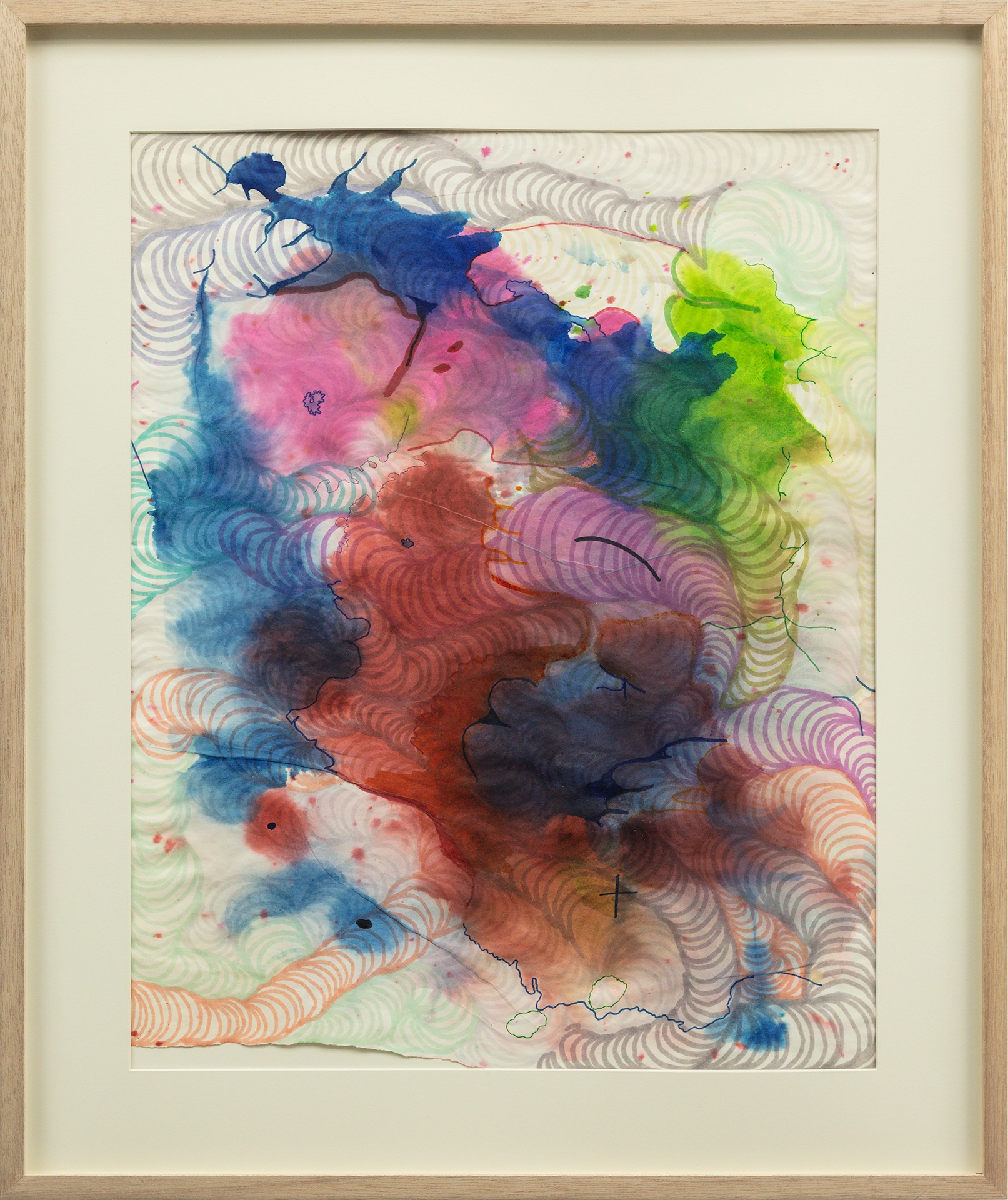
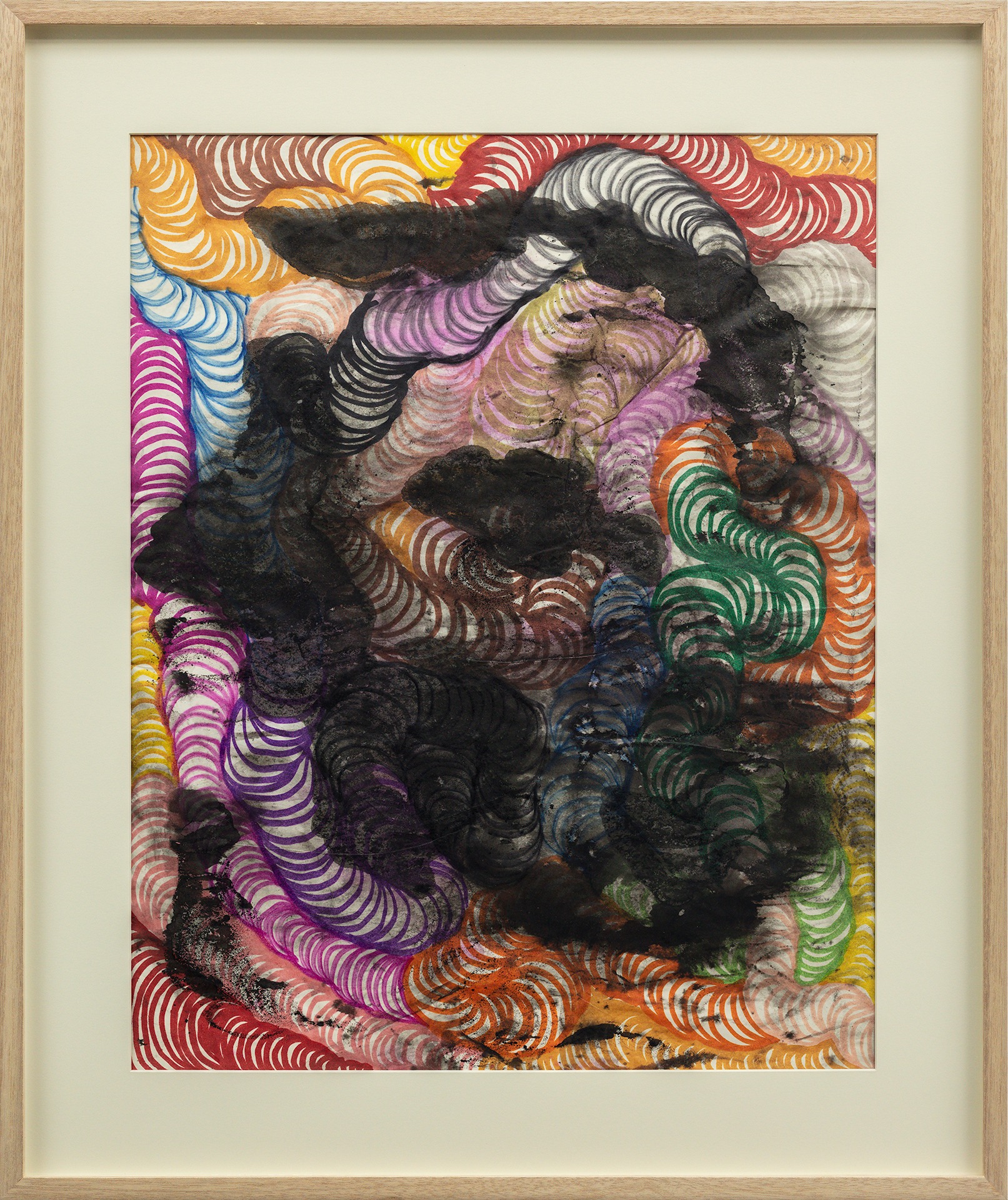
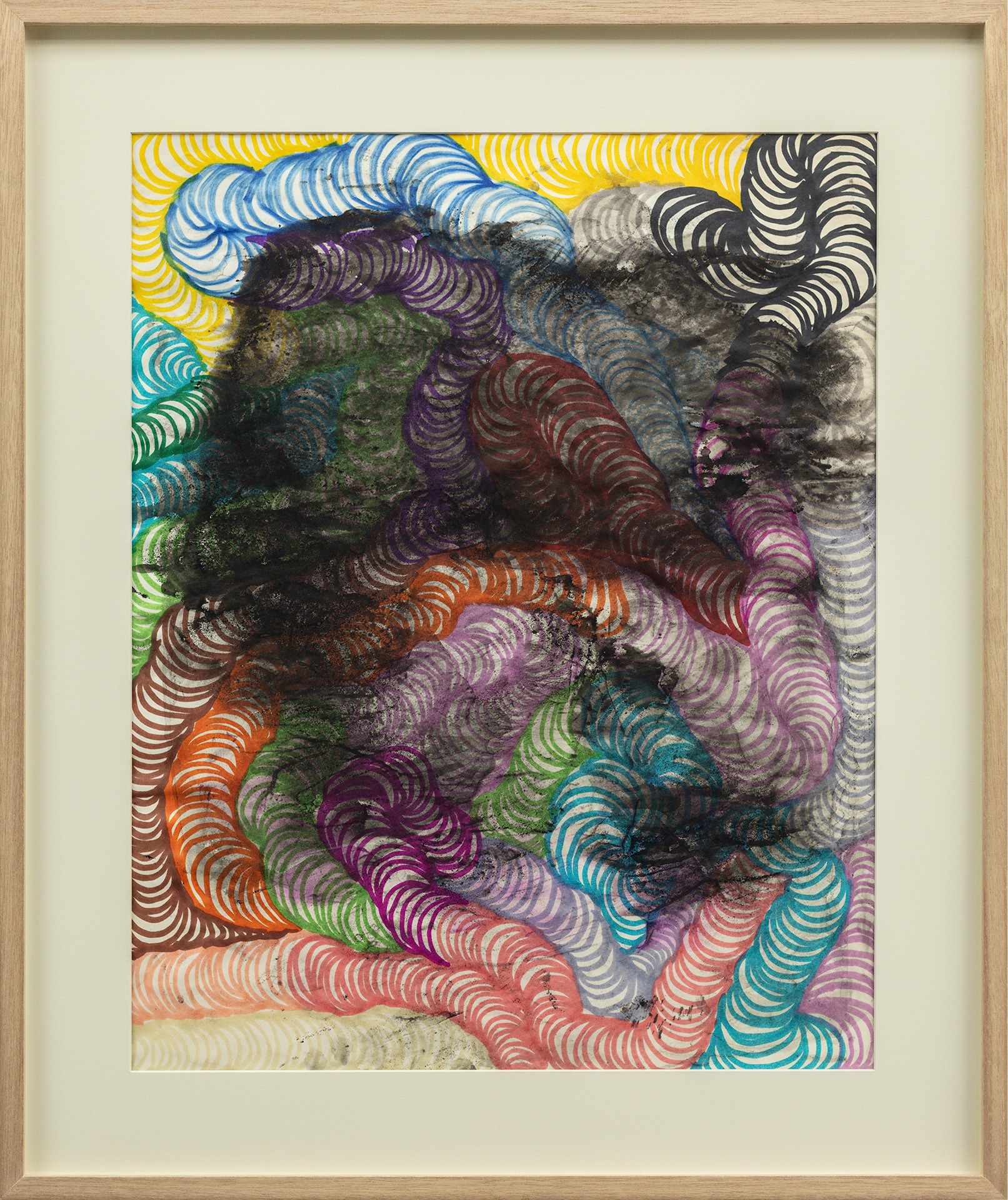
    That fluid intelligence is already evident in his early works on paper. Villa’s most recognizable motif, the coiling “slinky” form, appears throughout a group of drawings in looping technicolor lines. What begins as a simple spiral becomes a charged ribbon of energy. A personal glyph. The form rolls through many of his major works of the 1970s, from Tat2 self-portraits to ceremonial capes. These drawings were made during Villa’s time in New York City in the 1960s, when he was creating among downtown’s canonized figures while quietly developing a visual language that resisted assimilation.

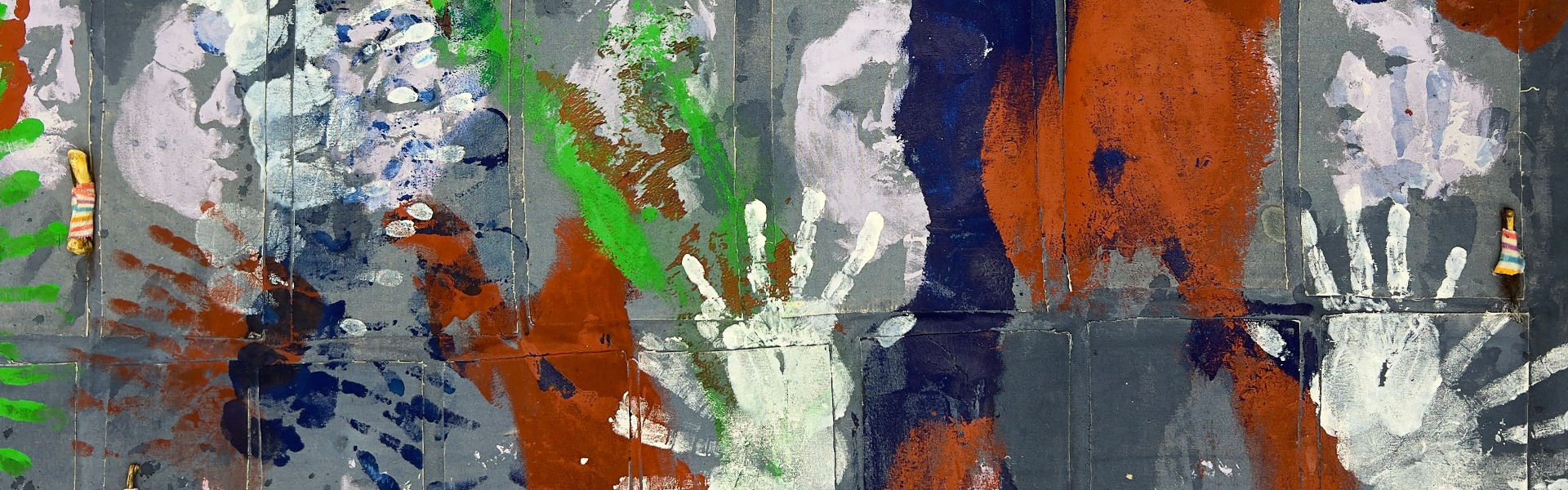
    The exhibition, however, is anchored by a group of large-scale 1980s body print paintings on unstretched canvas. Villa inked his naked form and pressed it directly onto the fabric: face, hands, limbs, torso. The gesture is direct, even blunt. A brown body marks space, refusing erasure. Years after his death, Villa still stands in the room.

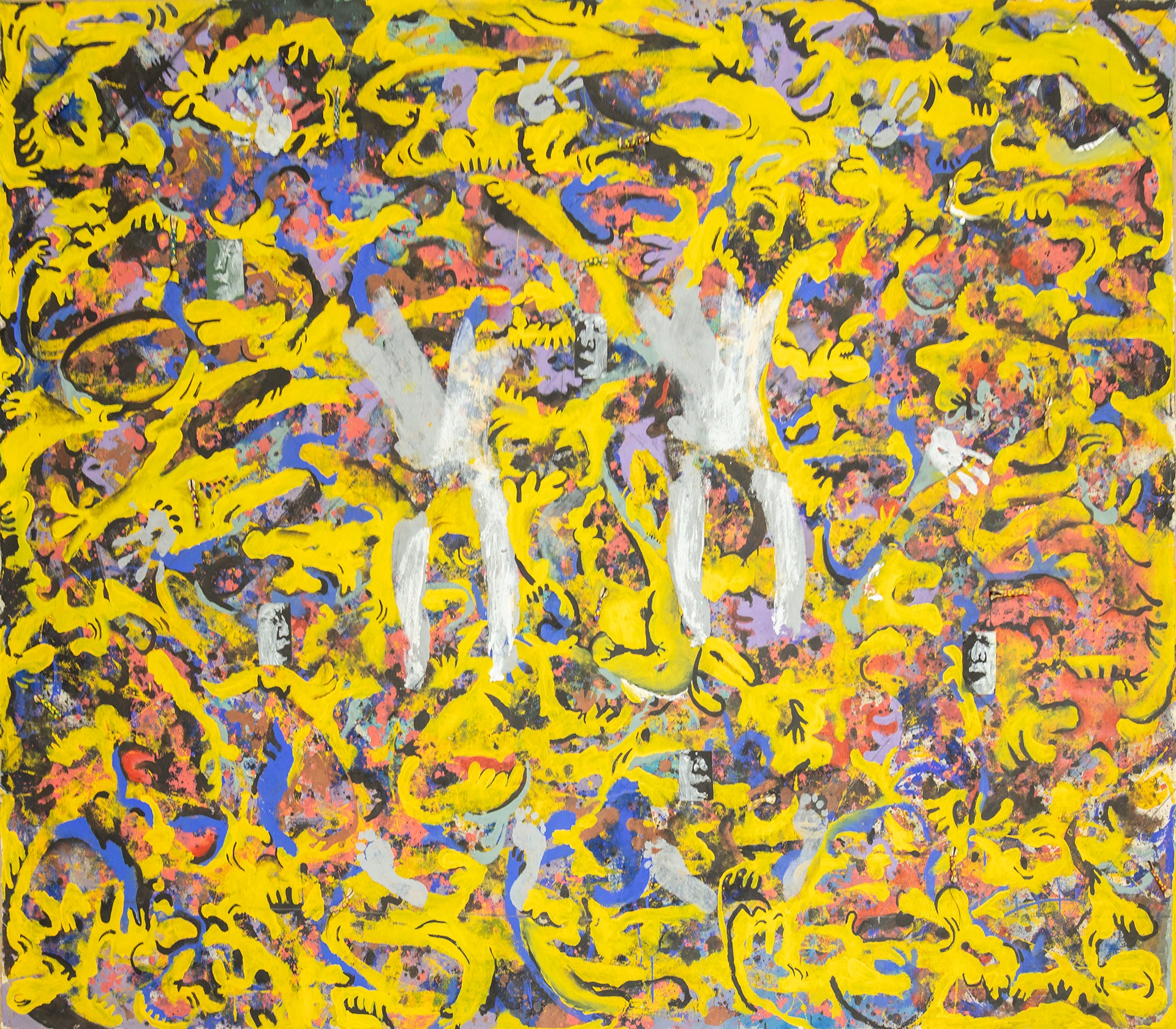
    The mural-scale painting Excavation stages a push and pull between bodily presence and protection. Here, Villa’s corporeal prints are camouflaged by cutout-like painted motifs. The blotchy shapes nod to the French bohemian artist Henri Matisse, one of Villa’s many influences. Simultaneously, they adopt the visual logic of American military camouflage. Its title carries dual associations: the act of unearthing what has been buried or pushed to the margins, and the labor of digging oneself out. Whatever Villa’s precise intent, the word “excavation” is anything but passive, reflecting his fundamentally active worldview. 

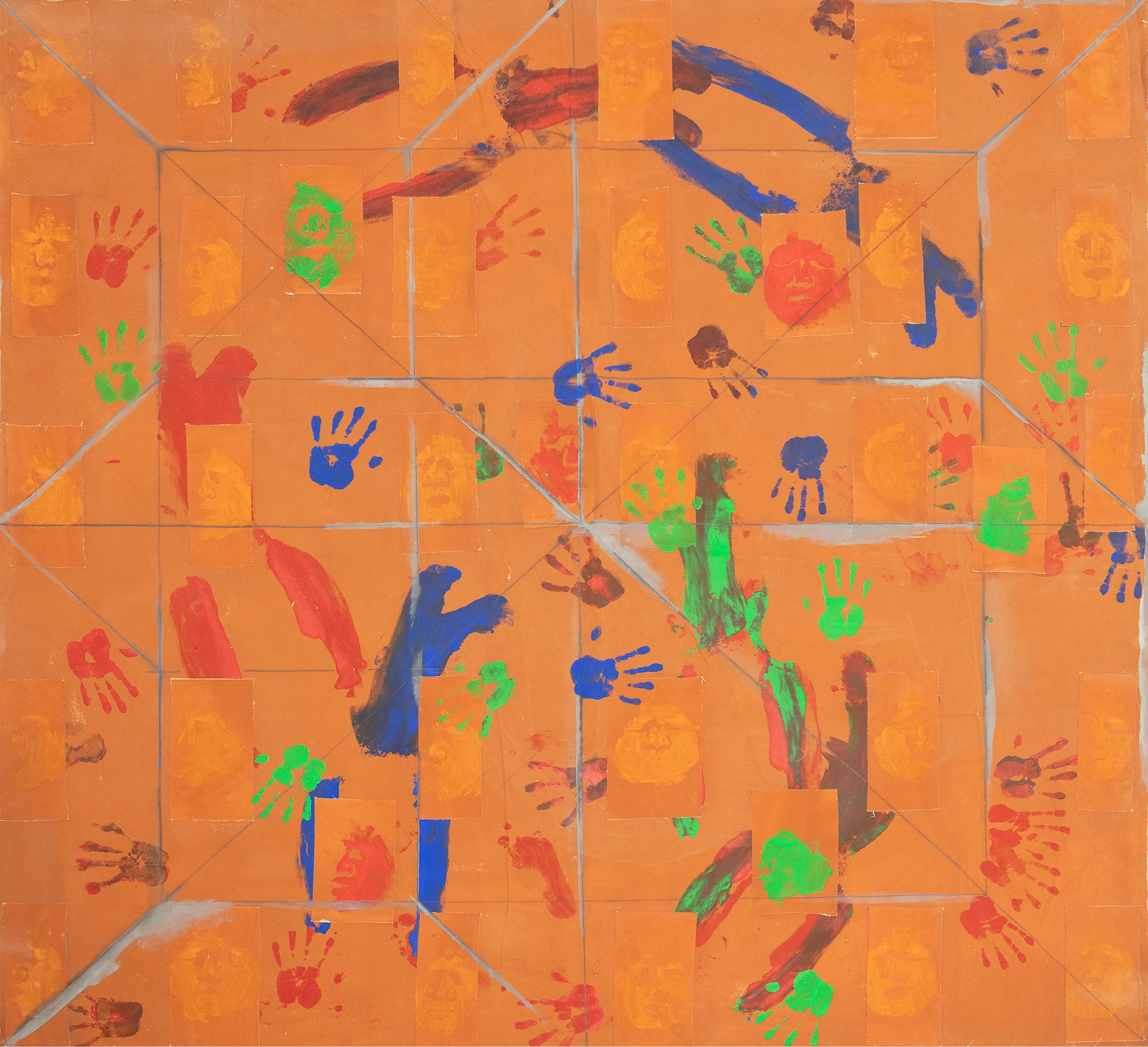
    Untitled (body prints on orange) is organized by a lattice of horizontal, vertical, and diagonal lines across a saturated orange ground. The armature conjures a quilt’s patchwork, extending Villa’s ongoing negotiation between so-called fine art and craft traditions. Across this structure, his swirling body prints gather momentum, airborne in full-volume red, blue, and green. The composition balances order and exuberance, the artist’s own form multiplied into a celebratory field. Villa remains the life of the party, even in absence. 

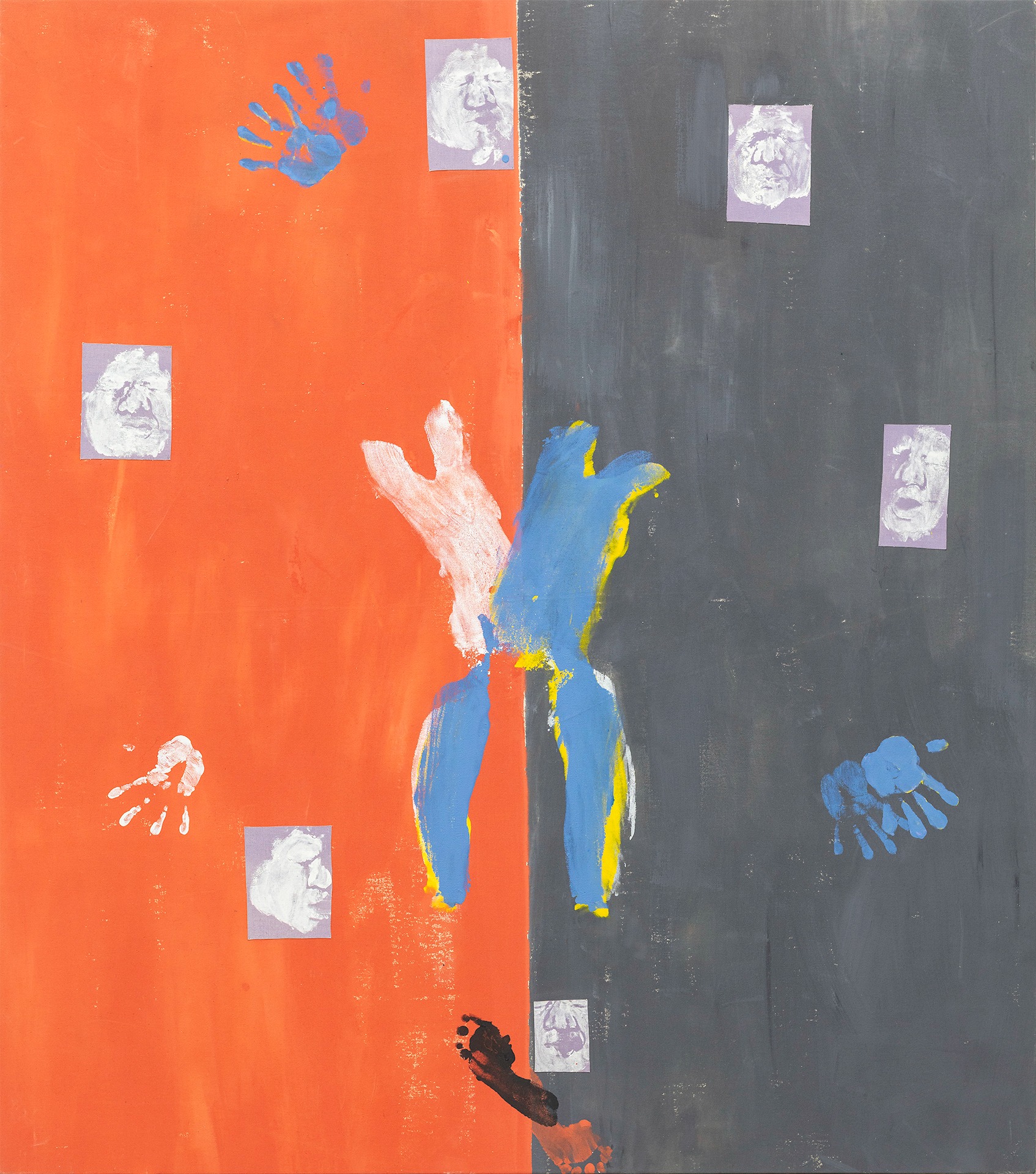
    In contrast, the graphic simplicity of Untitled (red and grey) reads like a flag. Bisected fields of red and bluish gray evoke national symbolism without settling into a single identity. The United States of America or the Republika ng Pilipinas? Why not, like Villa himself, a combination of both? At the center of the composition, torso prints are encircled by a radial halo of pale face impressions, recalling the sun of the Philippine flag and its assertion of unity, sovereignty, and emergence.

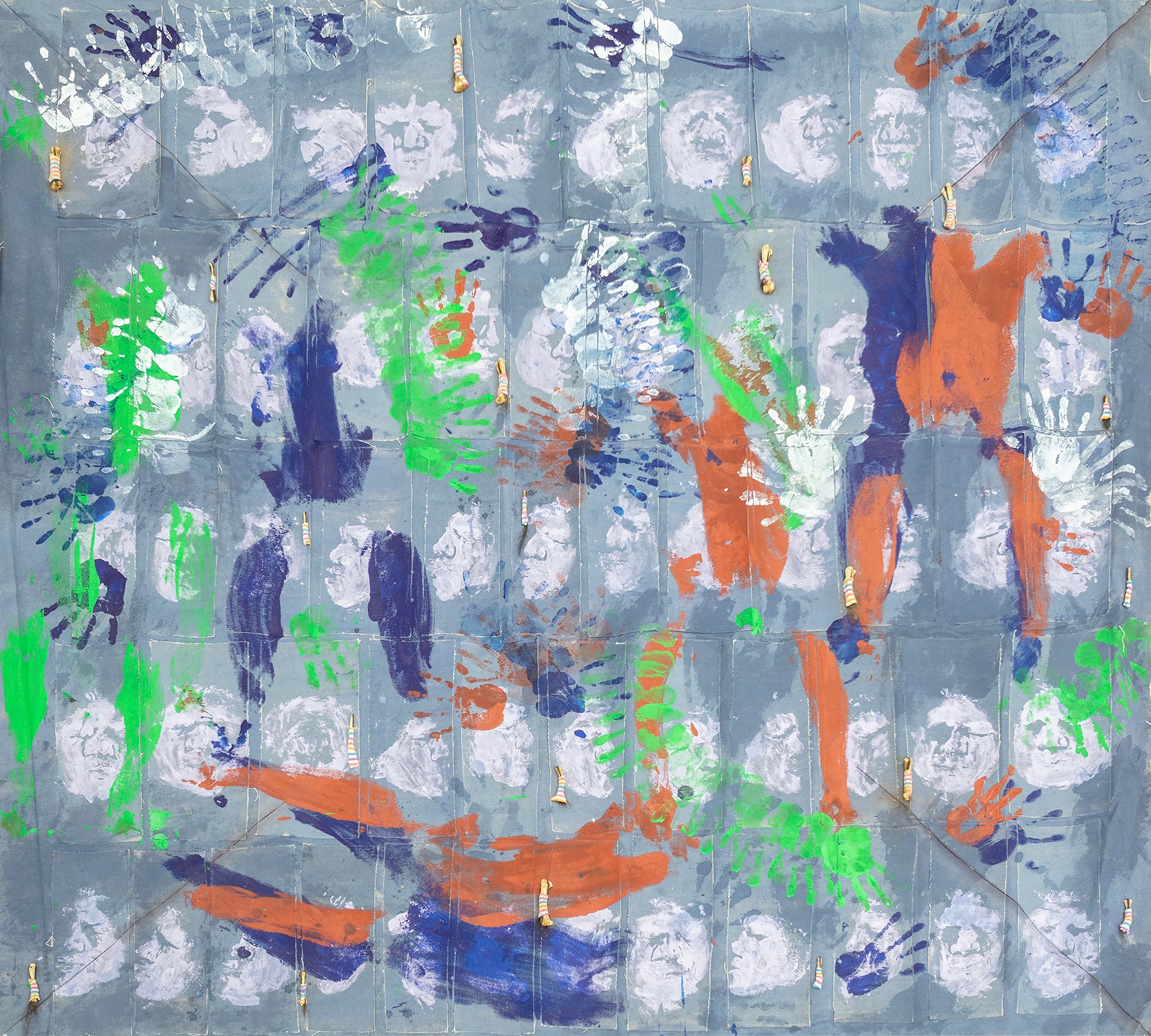
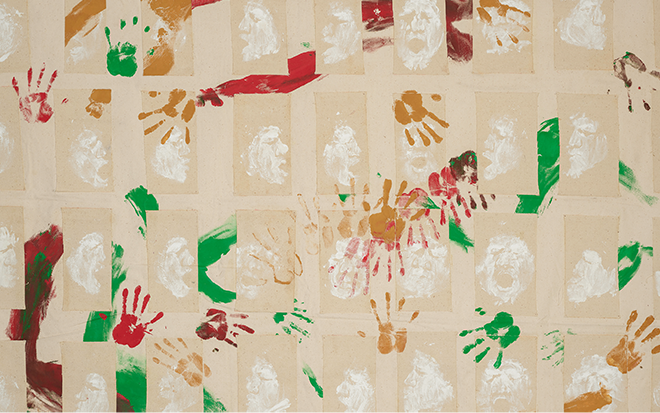
    In the titular painting Lying + Flying, a serial grid of bright white face prints is collaged onto the canvas ground and overlaid with imprints of body and hand. Further layered on top are chicken bones wrapped in scraps of fabric, which Villa affectionately called “señoritas” because, of course, they resembled women dancing. The work reflects Villa’s synthesis of ethnographic objects encountered in encyclopedic museums and the formal abstraction that came to define white-washed Western Modernism. Here, Villa expands the genre from within, not by discarding it, but by complicating its sources.

    Villa’s lone visit to the Philippines left a lasting impression. Traveling by jeepney and train, he filled yellow legal pads with observations and stream-of-consciousness thoughts, writing whenever he was not driving or drawing. The food reminded him of his mother’s cooking, yet introduced him to flavors he had never encountered. Learning that his family included many teachers and cooks offered him a lineage of care and transmission that mirrored his own path, strengthening his confidence in the life he had chosen. He returned with woven baskets and stories, but also with a sense of clarity.

    Lying + Flying does not seek closure. It situates us alongside an artist who refused fixed categories and easy resolution, insisting on plurality as a lived condition. His art asks how bodies press back, calling into question the governing boundaries between disciplines, cultures, and selves. Villa names these boundaries plainly: constricting lines that last only as long as we insist they do.

    Words by Katey Acquaro

    Carlos Villa (b. 1936 - d. 2013, San Francisco, USA) was a San Francisco-born visual artist, grass-roots activist, curator, author, and educator for over 40 years at the San Francisco Art Institute, among other Bay Area institutions.

    In 2022, Villa received the first-ever major museum retrospective dedicated to the work of a Filipino American artist, which toured from the Newark Museum of Art to the San Francisco Art Institute and Asian Art Museum. Villa’s works were also included in the 2011 solo retrospective Manongs, Some Doors and a Bouquet of Crates at the Mission Cultural Center for Latino Arts in San Francisco, and Other Sources: An American Essay, a multidisciplinary, multiethnic exhibition centered around women and artists of color, curated by Villa and presented in conjunction with the 1976 American Bicentennial.

More than a decade after his passing, Lying + Flying at Silverlens Manila marks Carlos Villa’s first dedicated exhibition in the Philippines, an archipelago that shaped him long before he ever set foot there. Born and raised in San Francisco to Philippine immigrant parents, Villa returned to his parents’ homeland only once during his lifetime. Yet the questions that animated his work, inheritance, belonging, collectivism, and the body as a political site, reverberate here with particular force.

Growing up in the multicultural and politically active Bay Area, art and politics were never separate for Villa. His life’s practice braided the two together, leaving an imprint that extended beyond his community and into the larger fabric of American Modernism. He taught, organized, made things, gathered people. Villa influenced generations, shifting ground not only through what he made and the hundreds he mentored, but also through how he moved in the world.

Friends of Villa will tell you that his relationships were inseparable from his art. His way of being with others was the art itself. Western art history often frames this orientation as radical, cycling through labels such as “participatory” or “social practice.” In an American context that prizes individualism, such work has been celebrated as a break from the myth that every man is an island. Yet in much of Southeast Asia, including the Philippines, collectivity is not a rupture but a foundation. Islands exist only in relation. Seen from this perspective, Villa’s emphasis on community reads less as an avant-garde strategy and more as inheritance, a way of life folded naturally into artistic production.

This affinity became visible in 2019, when Villa’s work was brought forward in Southeast Asia by Dr. Patrick Flores as part of the Singapore Biennale. Though the geographic context was new, his exuberant multimedia pieces registered immediately with audiences, not as historical correction, but as something legible and alive in the present.

The works in Lying + Flying, like the artist’s larger practice, masquerade as messy, but this is only a cartomancer’s bluff. Wait a moment and an architecture emerges, a cunning grid that ripples rather than locks into place. Villa understood composition as an organism, both organic and organized, a living system capable of holding contradiction without collapse.

That fluid intelligence is already evident in his early works on paper. Villa’s most recognizable motif, the coiling “slinky” form, appears throughout a group of drawings in looping technicolor lines. What begins as a simple spiral becomes a charged ribbon of energy. A personal glyph. The form rolls through many of his major works of the 1970s, from Tat2 self-portraits to ceremonial capes. These drawings were made during Villa’s time in New York City in the 1960s, when he was creating among downtown’s canonized figures while quietly developing a visual language that resisted assimilation.

The exhibition, however, is anchored by a group of large-scale 1980s body print paintings on unstretched canvas. Villa inked his naked form and pressed it directly onto the fabric: face, hands, limbs, torso. The gesture is direct, even blunt. A brown body marks space, refusing erasure. Years after his death, Villa still stands in the room.

The mural-scale painting Excavation stages a push and pull between bodily presence and protection. Here, Villa’s corporeal prints are camouflaged by cutout-like painted motifs. The blotchy shapes nod to the French bohemian artist Henri Matisse, one of Villa’s many influences. Simultaneously, they adopt the visual logic of American military camouflage. Its title carries dual associations: the act of unearthing what has been buried or pushed to the margins, and the labor of digging oneself out. Whatever Villa’s precise intent, the word “excavation” is anything but passive, reflecting his fundamentally active worldview. 

Untitled (body prints on orange) is organized by a lattice of horizontal, vertical, and diagonal lines across a saturated orange ground. The armature conjures a quilt’s patchwork, extending Villa’s ongoing negotiation between so-called fine art and craft traditions. Across this structure, his swirling body prints gather momentum, airborne in full-volume red, blue, and green. The composition balances order and exuberance, the artist’s own form multiplied into a celebratory field. Villa remains the life of the party, even in absence. 

In contrast, the graphic simplicity of Untitled (red and grey) reads like a flag. Bisected fields of red and bluish gray evoke national symbolism without settling into a single identity. The United States of America or the Republika ng Pilipinas? Why not, like Villa himself, a combination of both? At the center of the composition, torso prints are encircled by a radial halo of pale face impressions, recalling the sun of the Philippine flag and its assertion of unity, sovereignty, and emergence.

In the titular painting Lying + Flying, a serial grid of bright white face prints is collaged onto the canvas ground and overlaid with imprints of body and hand. Further layered on top are chicken bones wrapped in scraps of fabric, which Villa affectionately called “señoritas” because, of course, they resembled women dancing. The work reflects Villa’s synthesis of ethnographic objects encountered in encyclopedic museums and the formal abstraction that came to define white-washed Western Modernism. Here, Villa expands the genre from within, not by discarding it, but by complicating its sources.

Villa’s lone visit to the Philippines left a lasting impression. Traveling by jeepney and train, he filled yellow legal pads with observations and stream-of-consciousness thoughts, writing whenever he was not driving or drawing. The food reminded him of his mother’s cooking, yet introduced him to flavors he had never encountered. Learning that his family included many teachers and cooks offered him a lineage of care and transmission that mirrored his own path, strengthening his confidence in the life he had chosen. He returned with woven baskets and stories, but also with a sense of clarity.

Lying + Flying does not seek closure. It situates us alongside an artist who refused fixed categories and easy resolution, insisting on plurality as a lived condition. His art asks how bodies press back, calling into question the governing boundaries between disciplines, cultures, and selves. Villa names these boundaries plainly: constricting lines that last only as long as we insist they do.

Words by Katey Acquaro

Carlos Villa (b. 1936 - d. 2013, San Francisco, USA) was a San Francisco-born visual artist, grass-roots activist, curator, author, and educator for over 40 years at the San Francisco Art Institute, among other Bay Area institutions.

In 2022, Villa received the first-ever major museum retrospective dedicated to the work of a Filipino American artist, which toured from the Newark Museum of Art to the San Francisco Art Institute and Asian Art Museum. Villa’s works were also included in the 2011 solo retrospective Manongs, Some Doors and a Bouquet of Crates at the Mission Cultural Center for Latino Arts in San Francisco, and Other Sources: An American Essay, a multidisciplinary, multiethnic exhibition centered around women and artists of color, curated by Villa and presented in conjunction with the 1976 American Bicentennial.

Installation Views

Works
Carlos Villa
Excavation
1982
17026
2
acrylic on unstretched canvas with chicken bones
95h x 125w in 241.3h x 317.5w cm
-1
0.00
PHP
0
Details
Carlos Villa
Lying + Flying
1980
17027
2
acrylic, collaged canvas, bones, hair, and fabric on unstretched canvas
approx. 82h x 82w in approx. 208.3h x 208.3w cm
-1
0.00
PHP
0
Details
Carlos Villa
Untitled (red and grey)
1983
17029
2
acrylic on canvas
96hx
-1
0.00
PHP
0
77.5w in 243.8h x 196.8w cm
Details
Carlos Villa
Untitled (body prints on orange)
c. 1983
17028
2
acrylic on unstretched canvas
92h x 93w in 233.7h x 236.2w cm
-1
0.00
PHP
0
Details
Carlos Villa
Untitled (Slinky drawing)
c. 1960s
17031
2
Marker and ink on paper
30h x 26.75w x 1.66d in (framed) 76.3h x 68.1w x 4d cm
-1
0.00
PHP
0
(SLNY_CV043)
Details
Carlos Villa
Untitled (Slinky drawing)
c. 1960s
17030
2
Marker and ink on paper
30h x 26.75w x 1.66d in (framed) 76.3h x 68.1w x 4d cm
-1
0.00
PHP
0
(SLNY_CV044)
Details
Carlos Villa
Untitled (Slinky drawing)
c. 1960s
17032
2
Marker and ink on paper
23.88h x 18.88w in 60.5h x 48w cm 30h x 24.86w x 1.66d in (framed) 76.3h x 63.1w x 4d cm
-1
0.00
PHP
0
(SLNY_CV040)
Details
PHA+PHN0cm9uZz5TSUxWRVJMRU5TPC9zdHJvbmc+IGlzIGNvbW1pdHRlZCB0byBwcm90ZWN0aW5nIHlvdXIgcHJpdmFjeS4gSW4gY29tcGxpYW5jZSB3aXRoIHRoZSBQaGlsaXBwaW5lIFJlcHVibGljIEFjdCwgTm8uIDEwMTczIGJldHRlciBrbm93biBhcyB0aGUgMjAxMiBEYXRhIFByaXZhY3kgQWN0LCB3ZSBjYW4gb25seSB1c2UgdGhlIGluZm9ybWF0aW9uIHRoYXQgd2Ugb2J0YWluIGFib3V0IHlvdSBsYXdmdWxseS4gV2UgbWF5IGNvbGxlY3QgcGVyc29uYWwgaW5mb3JtYXRpb24gYWJvdXQgeW91IHdoZW4geW91IHNpZ24gdXAgZm9yIG91ciBuZXdzbGV0dGVyIG9yIGNvbnRhY3QgdXMgd2l0aCBhbiBpbnF1aXJ5LjwvcD4KPHA+VGhlIHR5cGUgb2YgaW5mb3JtYXRpb24gd2UgbWF5IGNvbGxlY3QgaW5jbHVkZXMgeW91ciA8c3Ryb25nPk5hbWU8L3N0cm9uZz4sIDxzdHJvbmc+RW1haWw8L3N0cm9uZz4sIGFuZCA8c3Ryb25nPkNvbnRhY3QgTnVtYmVyPC9zdHJvbmc+LjwvcD4KPHA+V2UgbWF5IGNvbGxlY3QgcGF5bWVudCBpbmZvcm1hdGlvbiBmcm9tIHlvdSB0byBmdWxmaWxsIHRyYW5zYWN0aW9ucy4gVG8gcHJvY2VzcyBwYXltZW50cywgd2UgbWF5IGNvbGxlY3QgeW91ciBjcmVkaXQgY2FyZCBhbmQgYmFuayBhY2NvdW50IGRldGFpbHMuIFRoaXMgaW5mb3JtYXRpb24gbWF5IGJlIHNoYXJlZCB3aXRoIHRoaXJkIHBhcnR5IHBheW1lbnQgcHJvY2Vzc2luZyBzZXJ2aWNlcy48L3A+CjxwPlRvIGRlbGl2ZXIgeW91ciBwdXJjaGFzZSwgd2UgbWF5IHByb3ZpZGUgeW91ciBwZXJzb25hbCBpbmZvcm1hdGlvbiB0byB0aGlyZC1wYXJ0eSBsb2dpc3RpY3MgY29tcGFuaWVzIHdobyBhc3Npc3QgdXMgd2l0aCBvdXIgZGVsaXZlcmllcyBhbmQgc2hpcG1lbnRzLjwvcD4KPHA+VGhlIHBlcnNvbmFsIGluZm9ybWF0aW9uIHdoaWNoIHdlIGhvbGQgd2lsbCBiZSBoZWxkIHNlY3VyZWx5IGluIGFjY29yZGFuY2Ugd2l0aCBvdXIgaW50ZXJuYWwgc2VjdXJpdHkgcG9saWN5LiBXZSB3aWxsIG5ldmVyIGNvbGxlY3QgaW5mb3JtYXRpb24gYWJvdXQgeW91IHdpdGhvdXQgeW91ciBleHBsaWNpdCBjb25zZW50LjwvcD4KPHA+VGhlIGluZm9ybWF0aW9uIHdlIHN0b3JlIHdpbGwgYmUgYWNjdXJhdGUgYW5kIHVwIHRvIGRhdGUuIFlvdSBjYW4gY2hlY2sgdGhlIGluZm9ybWF0aW9uIHRoYXQgd2UgaG9sZCBhYm91dCB5b3UgYnkgZW1haWxpbmcgdXMuIElmIHlvdSBmaW5kIHRoYXQgdGhlcmUgYXJlIGFueSBpbmFjY3VyYWNpZXMsIHdlIHdpbGwgZGVsZXRlIG9yIGNvcnJlY3QgaXQgcHJvbXB0bHkuPC9wPgo8cD5XZSBtYXkgdXNlIHRlY2hub2xvZ3kgdG8gdHJhY2sgdGhlIHBhdHRlcm5zIG9mIGJlaGF2aW9yIG9mIHZpc2l0b3JzIHRvIG91ciB3ZWJzaXRlLiBUaGlzIG1heSBpbmNsdWRlIHVzaW5nIGEgImNvb2tpZSIgc3RvcmVkIG9uIHlvdXIgYnJvd3NlciB3aGljaCB5b3UgY2FuIHVzdWFsbHkgbW9kaWZ5IHRocm91Z2ggeW91ciBicm93c2VyIHRvIHByZXZlbnQgdGhpcyBmcm9tIGhhcHBlbmluZy48L3A+CjxwPldlIHdpbGwgcmV0YWluIHlvdXIgcGVyc29uYWwgaW5mb3JtYXRpb24gb25seSB3aGlsZSB3ZSBuZWVkIGl0IGZvciB0aGUgcmVhc29ucyBzdGF0ZWQgYWJvdmUgb3IgdW50aWwgeW91IHJlcXVlc3QgdGhhdCB3ZSBkZWxldGUgaXQgb24gb3VyIHJlY29yZHMuPC9wPgo8cD5JZiB5b3UgaGF2ZSBhbnkgcXVlc3Rpb25zIG9yIGNvbW1lbnRzIGFib3V0IG91ciBwcml2YWN5LCBwbGVhc2UgY29udGFjdCB1cyBhdCA8YSBocmVmPSJtYWlsdG86aW5xdWlyeUBzaWx2ZXJsZW5zZ2FsbGVyaWVzLmNvbSI+aW5xdWlyeUBzaWx2ZXJsZW5zZ2FsbGVyaWVzLmNvbTwvYT48L3A+
R2FpbiBhY2Nlc3MgdG8gZXhjbHVzaXZlIGdhbGxlcnkgaW5mb3JtYXRpb24sIGxhdGVzdCBleGhpYml0aW9ucywgPGJyIC8+CmFuZCBhcnRpc3QgdXBkYXRlcyBieSBzaWduaW5nIHVwIGZvciBvdXIgbmV3c2xldHRlciBiZWxvdy4=