The Orchid Pavilion

Wawi Navarroza
Silverlens, Manila

About

    “When future generations look back to my time, it will probably be similar to how I now think of the past.”

    Wang Xizhi
    Preface to the Poems Composed at the Orchid Pavilion (Lantingji Xu)
    353 CE

    The Orchid Pavilion, the first of Navarroza’s trilogy of exhibitions, considers the exchanges and acculturations that accompanied the movement of people and objects through the Philippines before and during the centuries of the Manila Galleon trade. It focuses on the country’s pan-Asian heritage and, more specifically, on the longstanding Chinese presence woven into Filipino culture and identity.

    Taking literature and poetry as points of departure, Navarroza turns to the Philippines’ layered past, looking beyond its broad strokes—heroes, events, and unified narratives—to the details within them. She approaches history through a sensorial lens, conjuring the atmosphere of Manila as a bustling, cosmopolitan entrepôt where disparate people, languages, objects, and traditions converged.

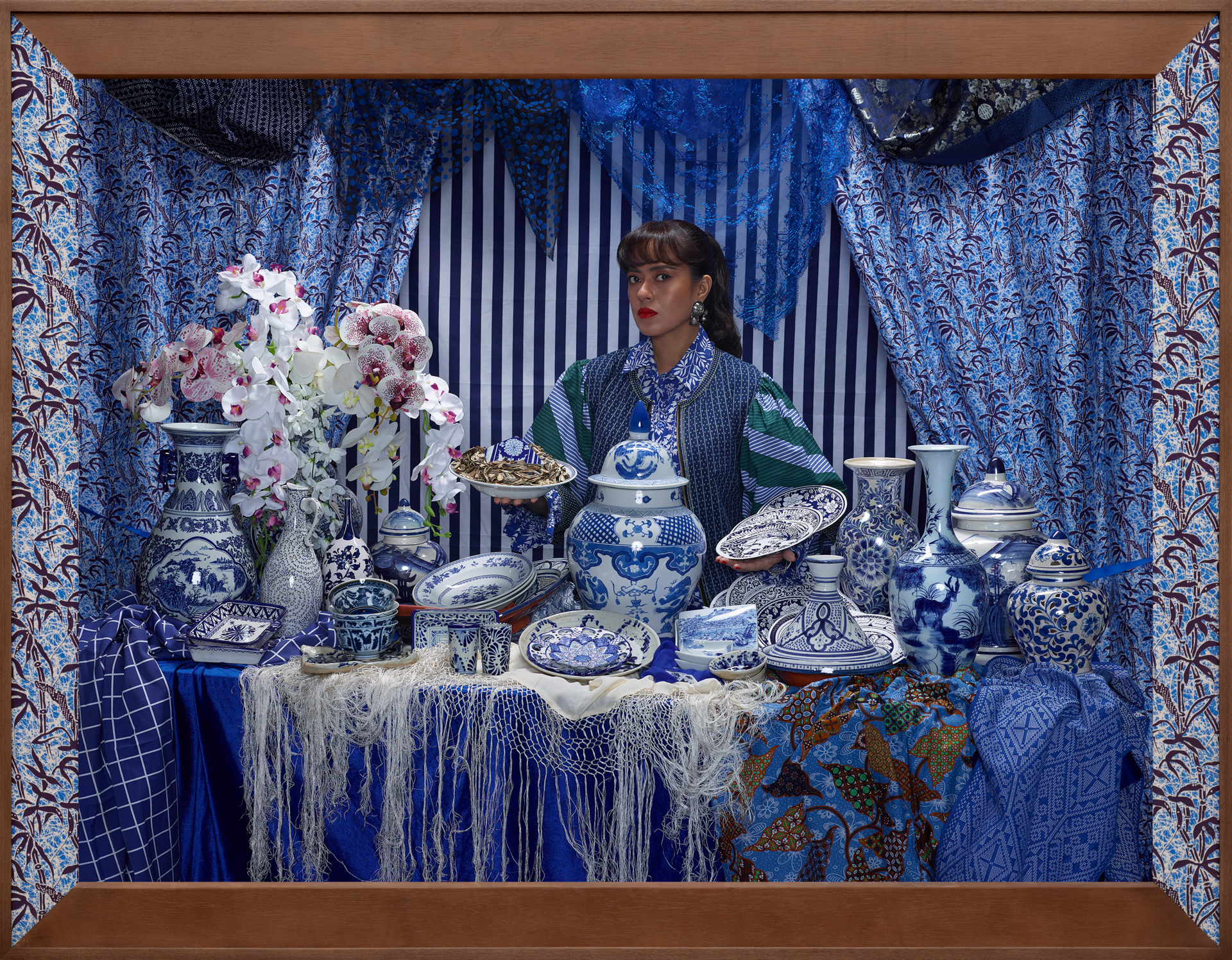
    Among the material traces of these exchanges, few are as ubiquitous as blue-and-white ceramics. Developed in China and present-day Iraq from around the ninth century, they circulated widely across the world. In Ten Thousand Things (Blue and White, Self-Portrait with Promise Piece), Navarroza is surrounded by vessels in a myriad of forms, while carrying their contemporary paper-plate imitations. Their persistence across regions is echoed by fabrics from different cultures in the same hues—Yakan weaves, cotton batik, and lace—bringing together materials whose shared palette belies their disparate origins.

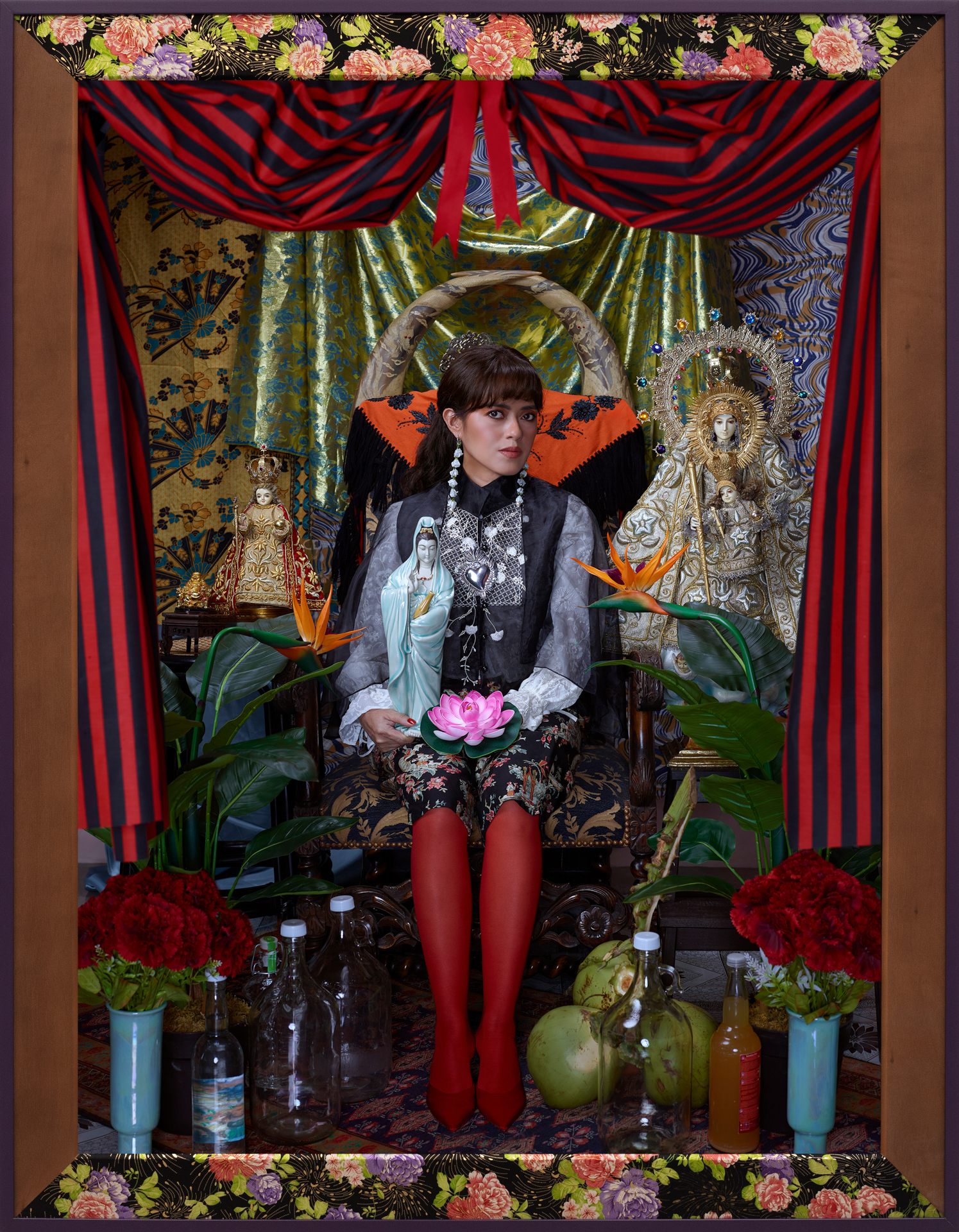
    While ceramics bear their histories of circulation visibly, other forms of cultural exchange are less obvious. Catholic devotional statues are commonly understood as a legacy of Spanish colonization, yet scholars have argued that Marian images in the Philippines were carved by Chinese craftsmen who drew upon representations of Buddhist deities as models. Devotion (Syncretismo: La Bruja III) points to these influences and the different traditions that have come together in objects we now think of as Filipino.

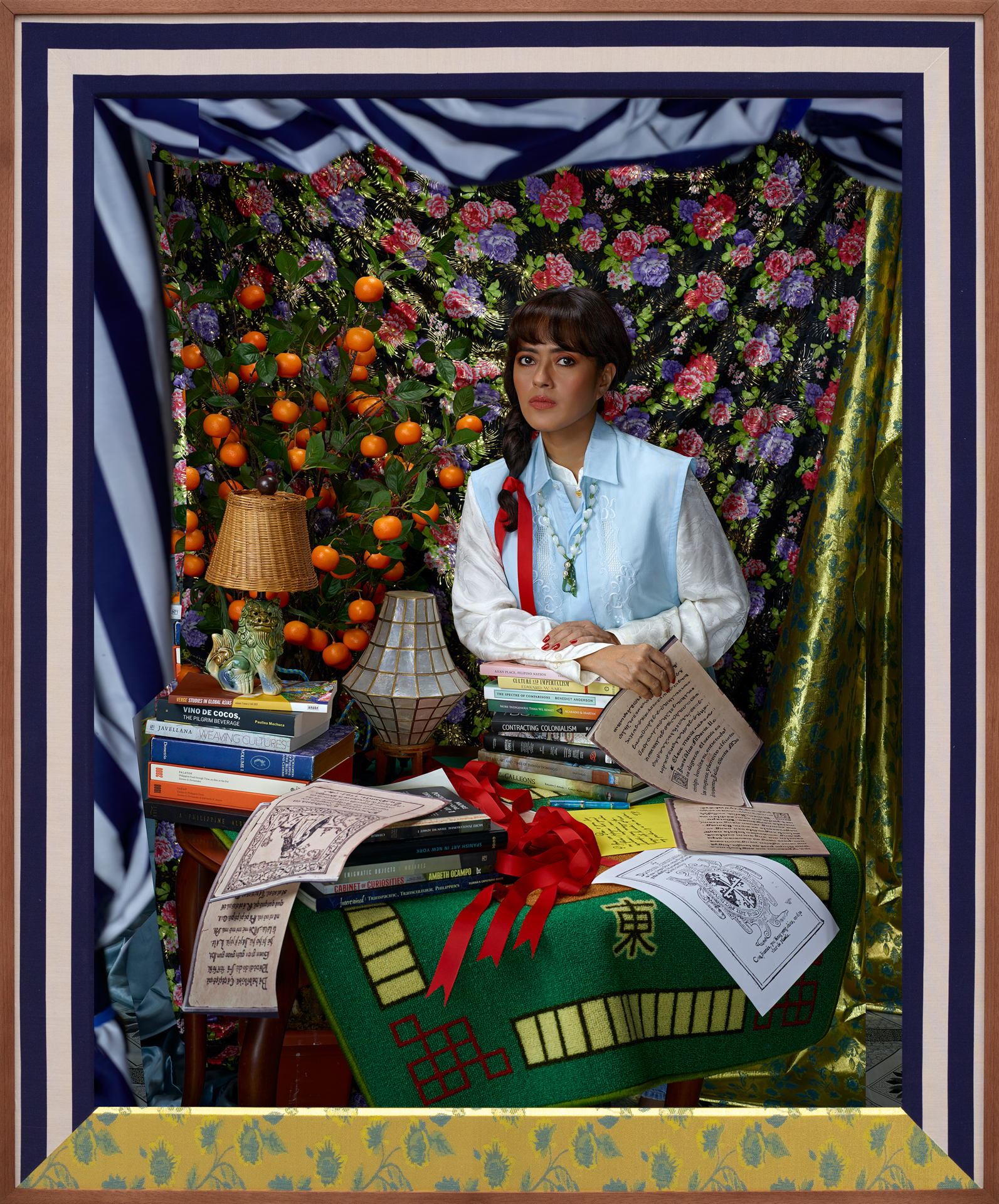
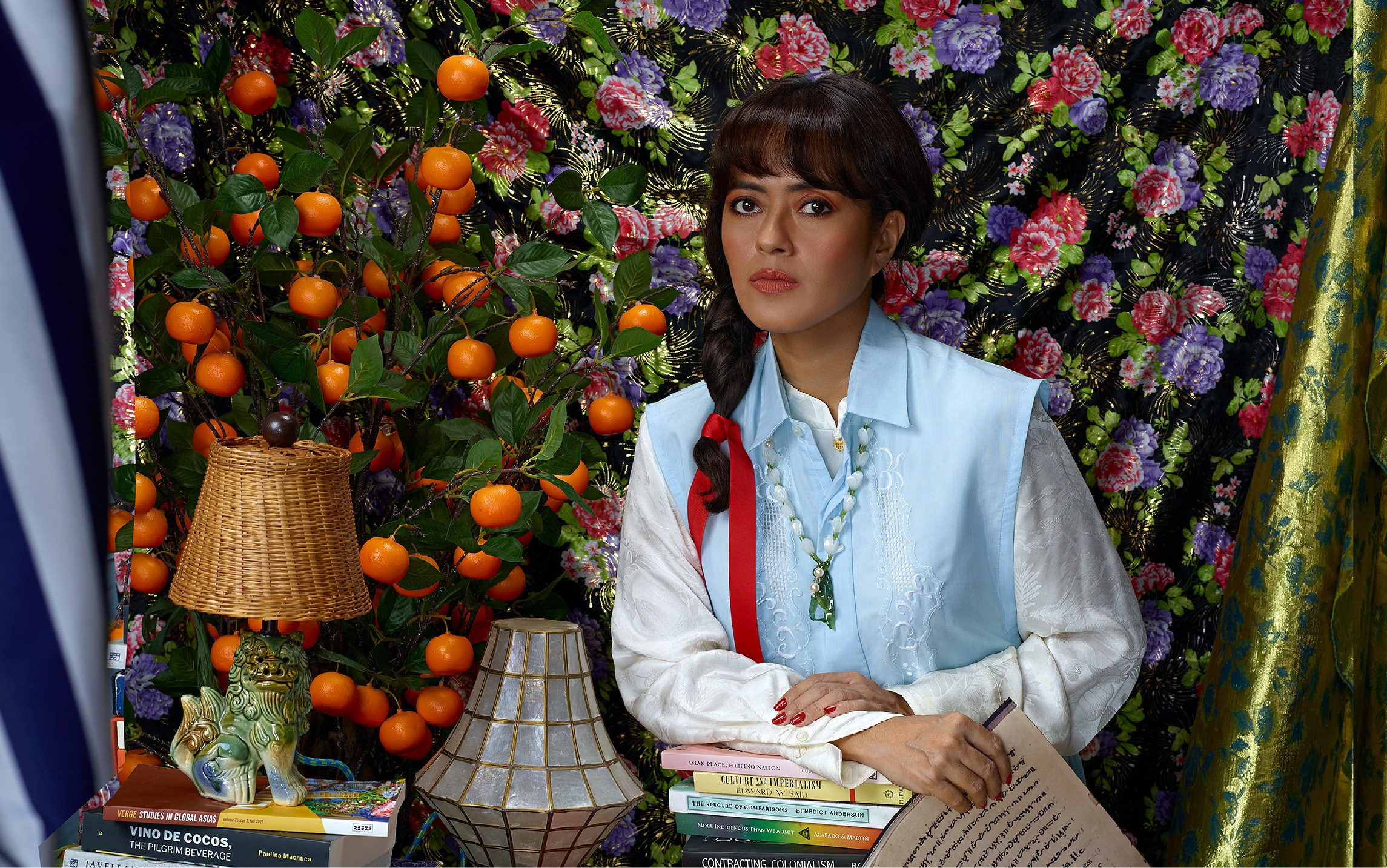
    This movement between cultural languages finds another form in Triple-Tongued (The Artist as Scholar, Self-Portrait as Ladino). Like the ladinos of the Spanish colonial period, who moved between the language of the colonizer and their native tongues, Navarroza moves between different systems of knowledge and expression. Of all the portraits in the exhibition, this is perhaps the one in which she most explicitly reveals herself. The artist appears as scholar and polyglot—Navarroza herself speaks six languages—an intellectual omnivore drawing from different worlds of language and culture. In assuming the figure of the ladino, she imagines herself as part of a tradition of those who moved between languages and cultures, carrying cultural understanding from one to another.

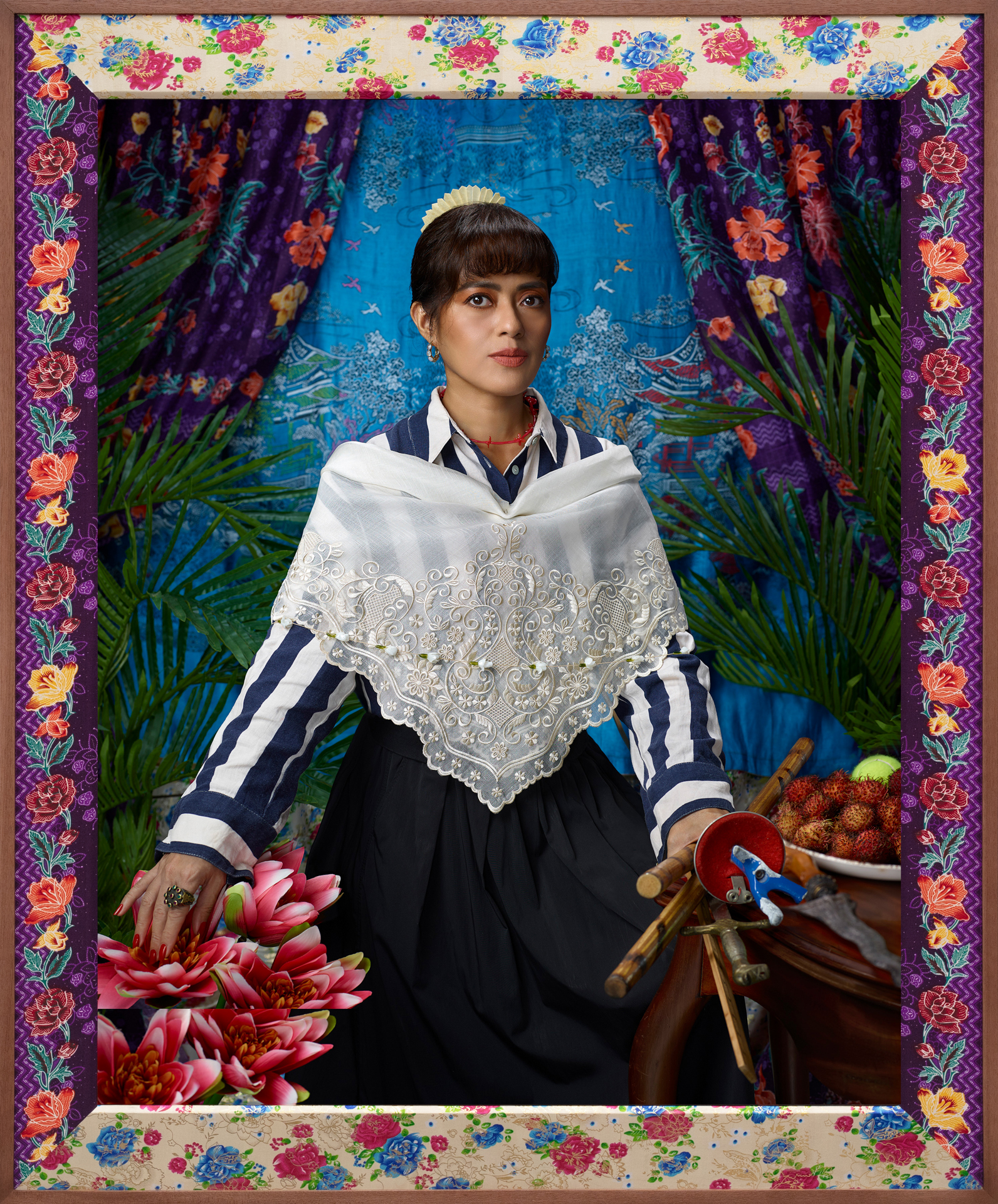
    In Ilustrada (Self-Portrait after Justiniano Asuncion’s “Portrait of Filomena Asuncion Villafranca”), Navarroza assumes the pose of the earlier portrait but introduces contemporary points of reference that suggest a fuller personality than the historical image allows us to see. Asuncion’s portrait tells us how a woman of her class was represented, but little about who she might have been. Navarroza’s pictures do not attempt to illustrate history. Instead, they propose ways of imagining it.

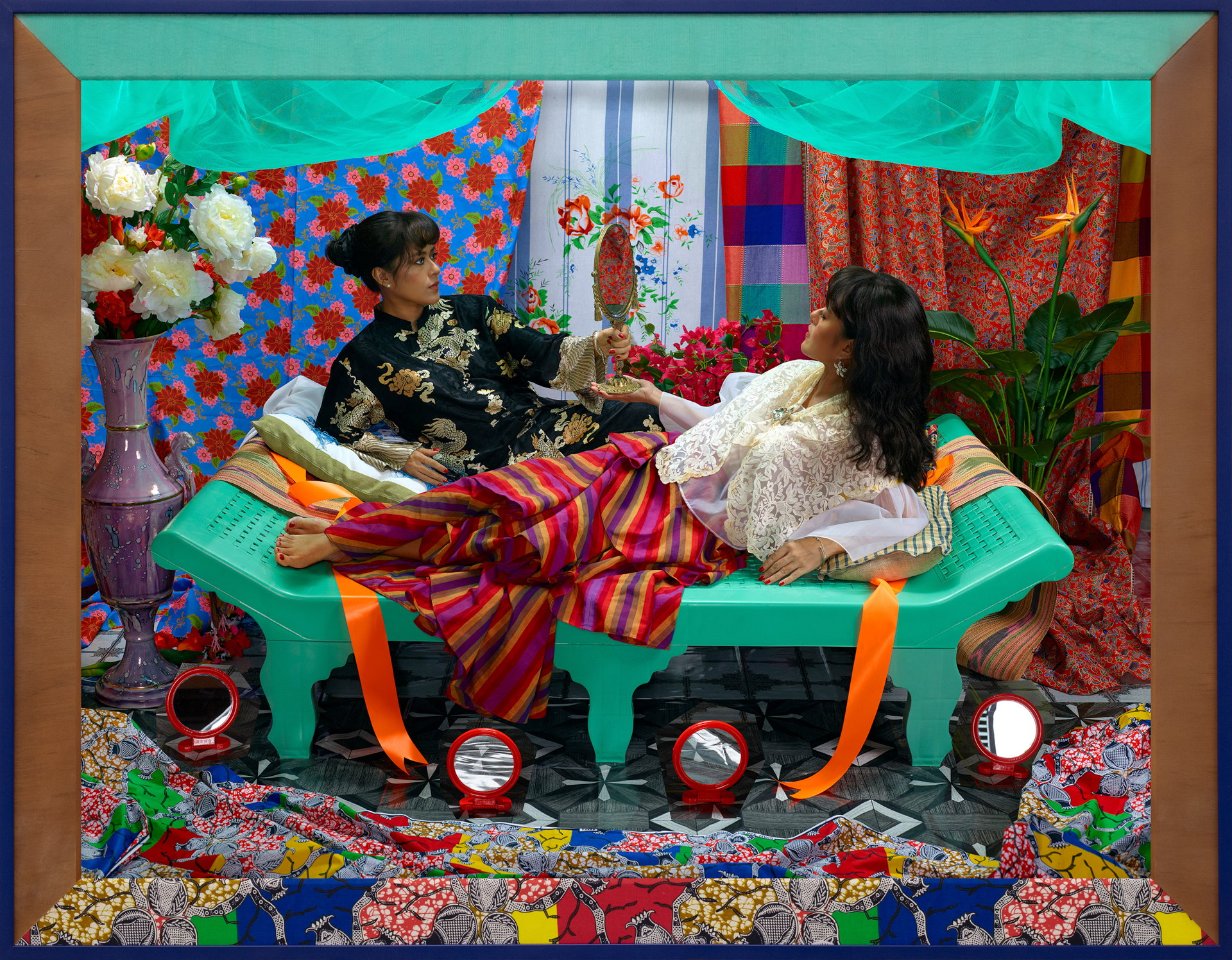
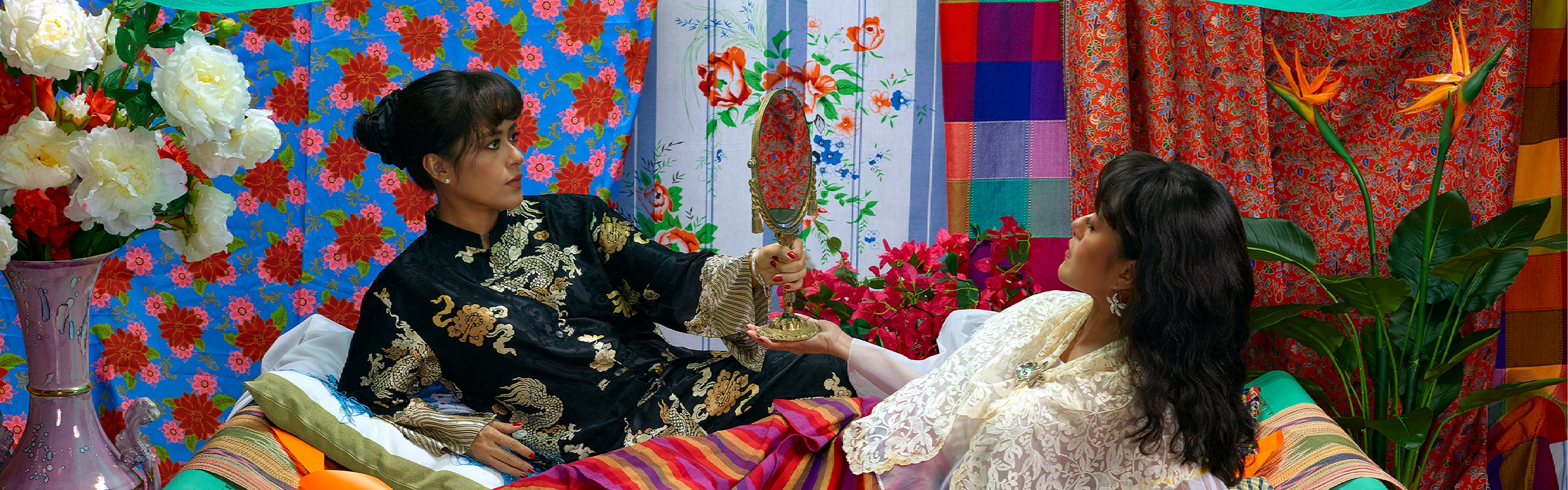
    Art history and literature feed Navarroza’s aesthetic universe, their imagery absorbed and reimagined within her own. Double-Naveled (The Filipino & the Foreign, Self-Portrait) takes its title from Nick Joaquin’s classic novel, with its questions of national identity and received history, while returning to a device familiar in Navarroza’s work: two sides of her persona confronting one another. The figures share a divan and seemingly inspect each other, though each is looking into a mirror held between them. Other mirrors scattered across the floor return unexpected fragments rather than what lies before them. Navarroza has collaged these mirrors into the photograph, deliberately leaving visible the sharp edges of the pieces she has cut and pasted. The technique disturbs the perfection of the photograph while calling into question what Navarroza herself sees in the mirror she holds, reflecting the complicated process of exploring identity and the entangled histories that have shaped it.

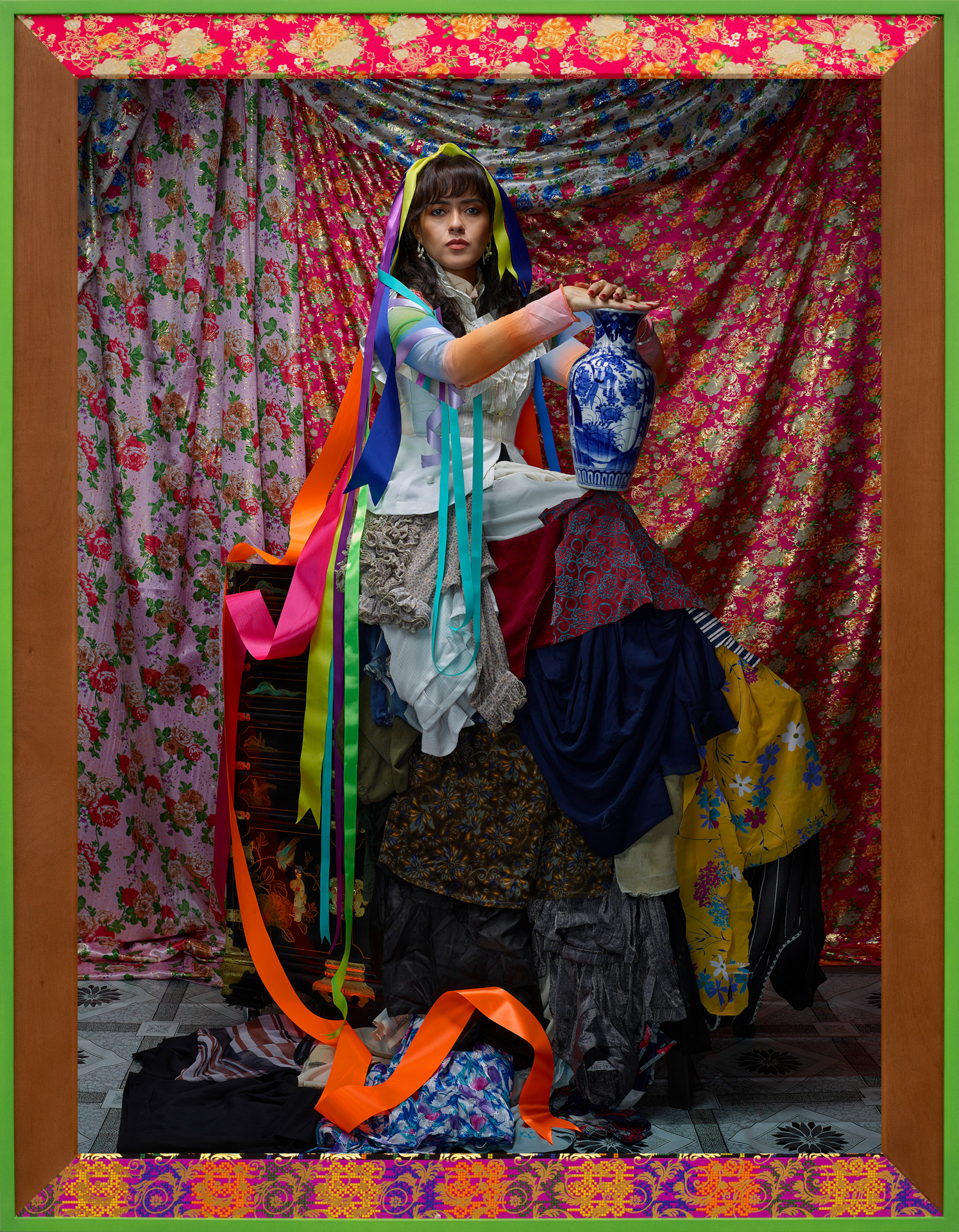
    In One Hundred Lives (Self-Portrait as a Phoenix: Fenghuang), Navarroza presents the feminine triumphant. She sits stoic and self-possessed atop a mountain of fabric, balancing a precious blue-and-white vase on one knee. There is something protective and defiant in the gesture, a sense that she can safeguard that which matters. But the work moves beyond the triumph of the individual. Navarroza wears Patricia Eustaquio’s All Dressed Up, a dress composed of one hundred garments sourced from ukay-ukay, which for Navarroza signifies “the many lives and roles women take on all at once,” its fragments becoming pieces in the fabric of women’s stories. That the dress is itself the work of another woman artist, lent by Eustaquio for Navarroza to wear, introduces another form of exchange: one grounded in the support and generosity between women. Here, as throughout the large portraits in the exhibition, fabrics spill beyond the photograph and onto its frame, extending the image into the physical space of the work and emphasizing its object-ness.

    Although Navarroza appears throughout The Orchid Pavilion, these are not self-portraits in the traditional sense. She describes using her body as a medium, “like a babaylan,” invoking the precolonial Philippine spiritual figure. Her body remains constant while costume, gesture, and attributes change, allowing her to inhabit different personas within the photographs. The more frequently Navarroza appears, the less the photographs seem to be about Navarroza herself.

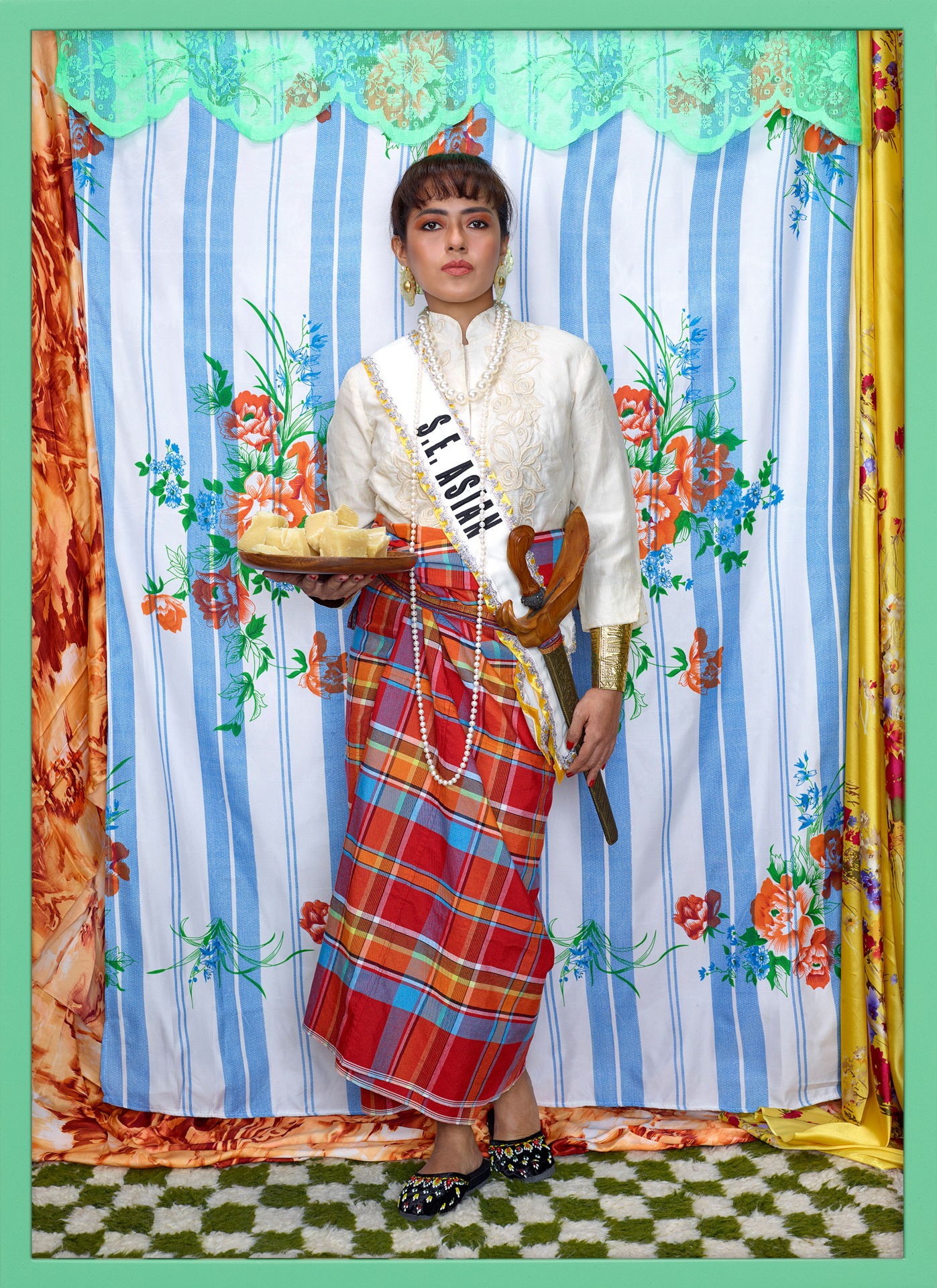
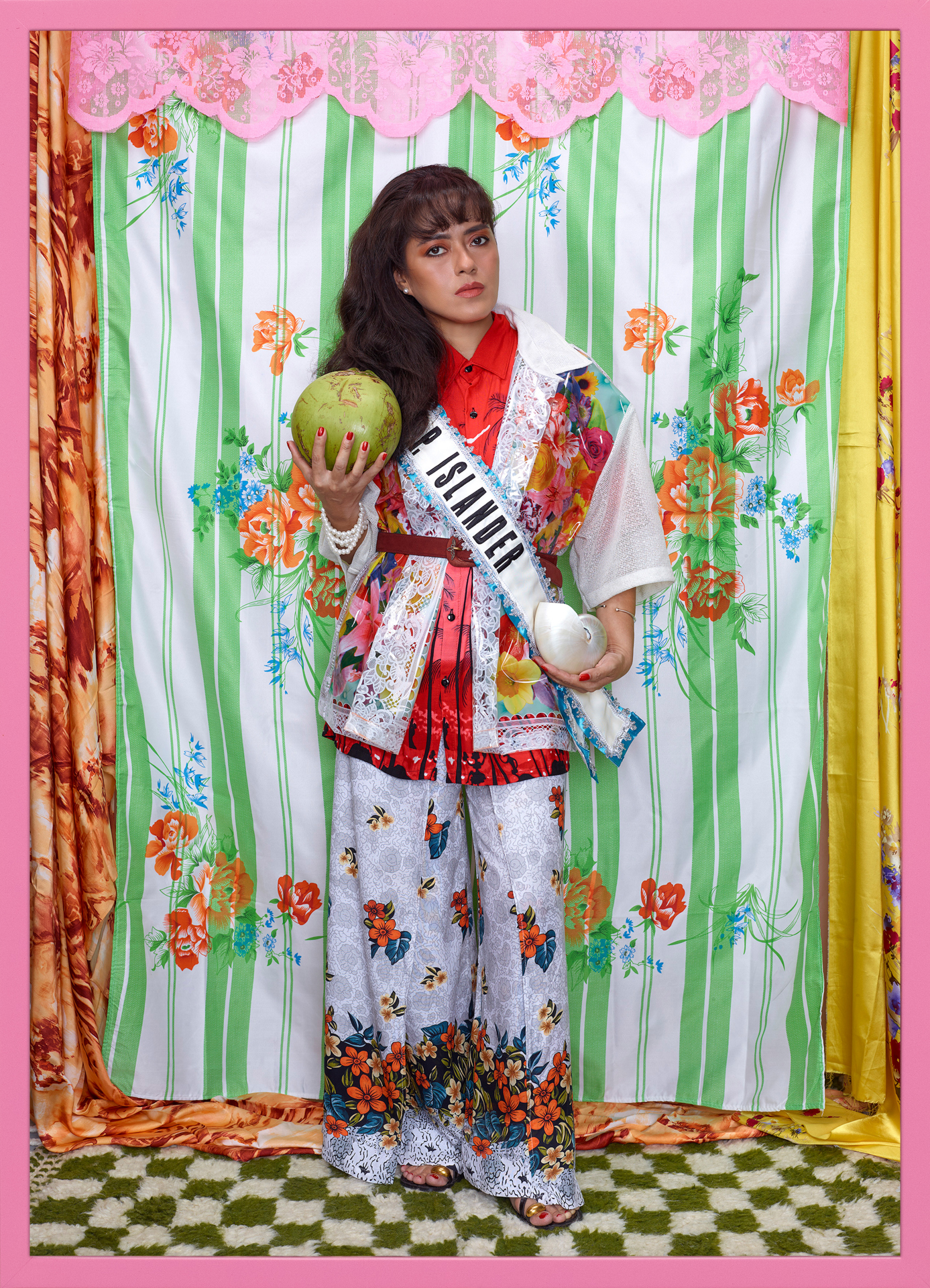
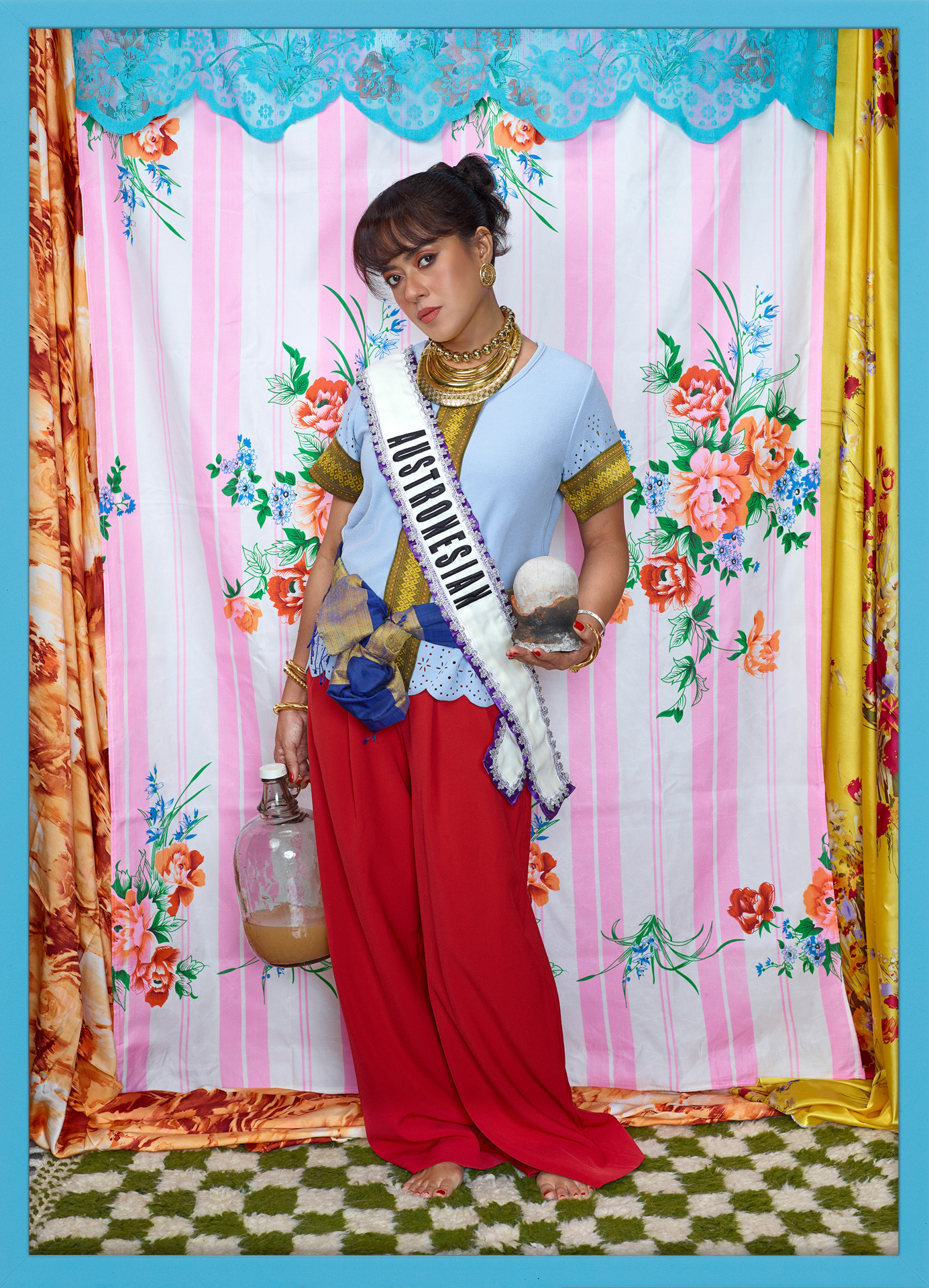
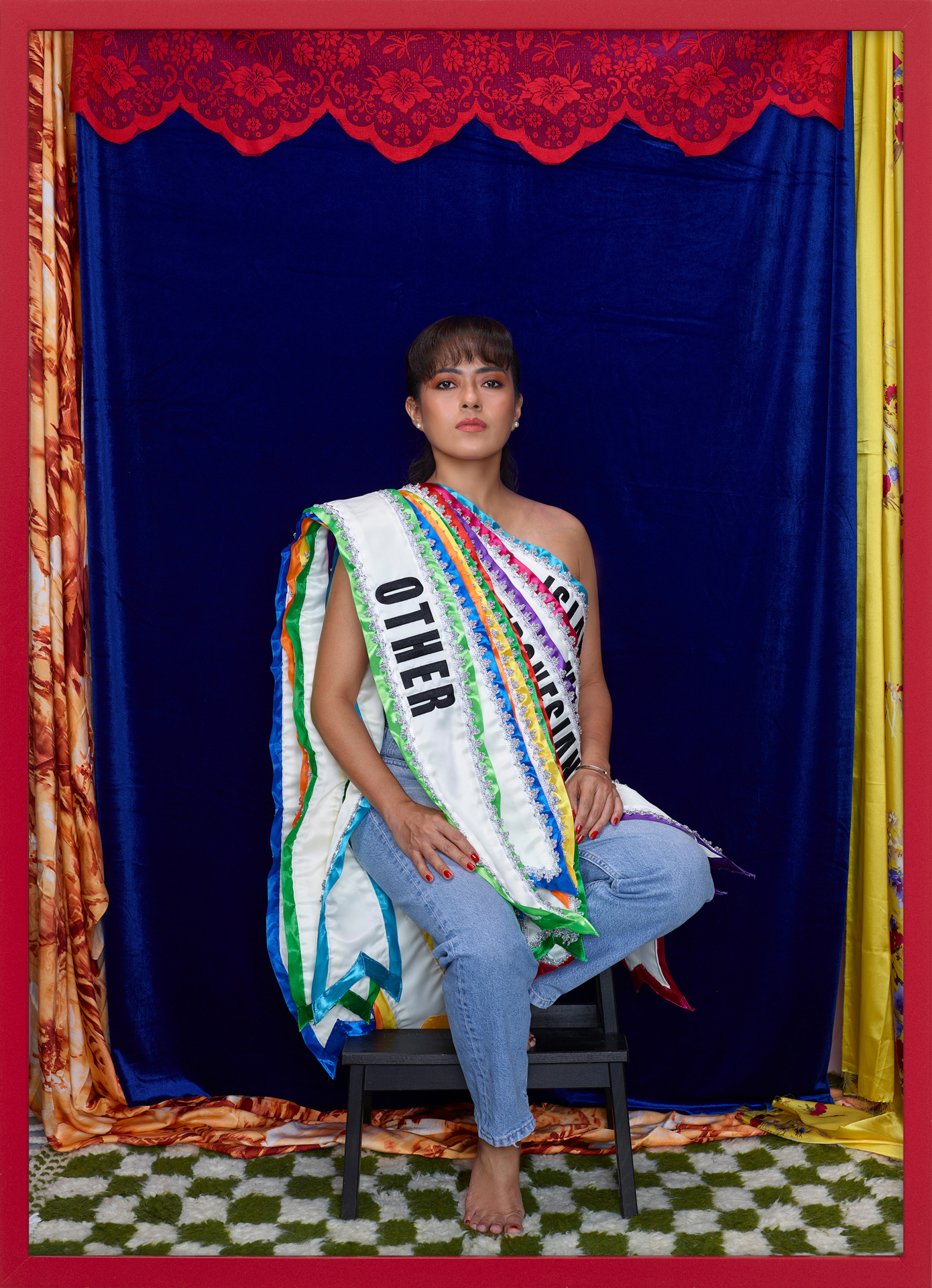
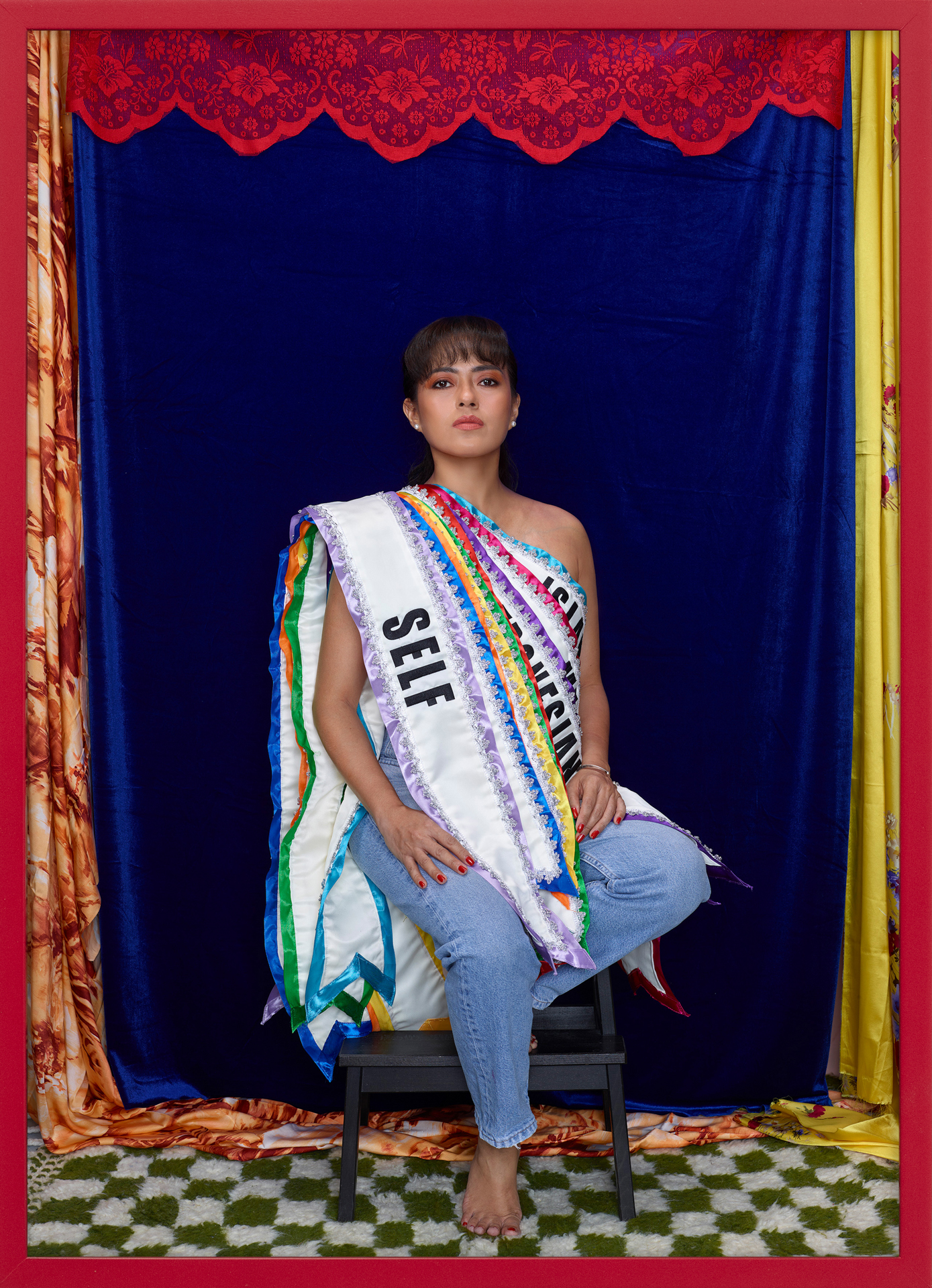
    Navarroza’s assumption of different identities takes a more critical turn in the Plural and Polymodal Riddle series, where she questions the categories that continue to be imposed upon people. Drawing on colonial visual typologies—from the Boxer Codex to tipos del país and costumbrista painting—she poses with attributes associated with each label, their classifications emblazoned across pageant-style sashes. The works challenge labels in which the very people they are meant to define may not recognize themselves.

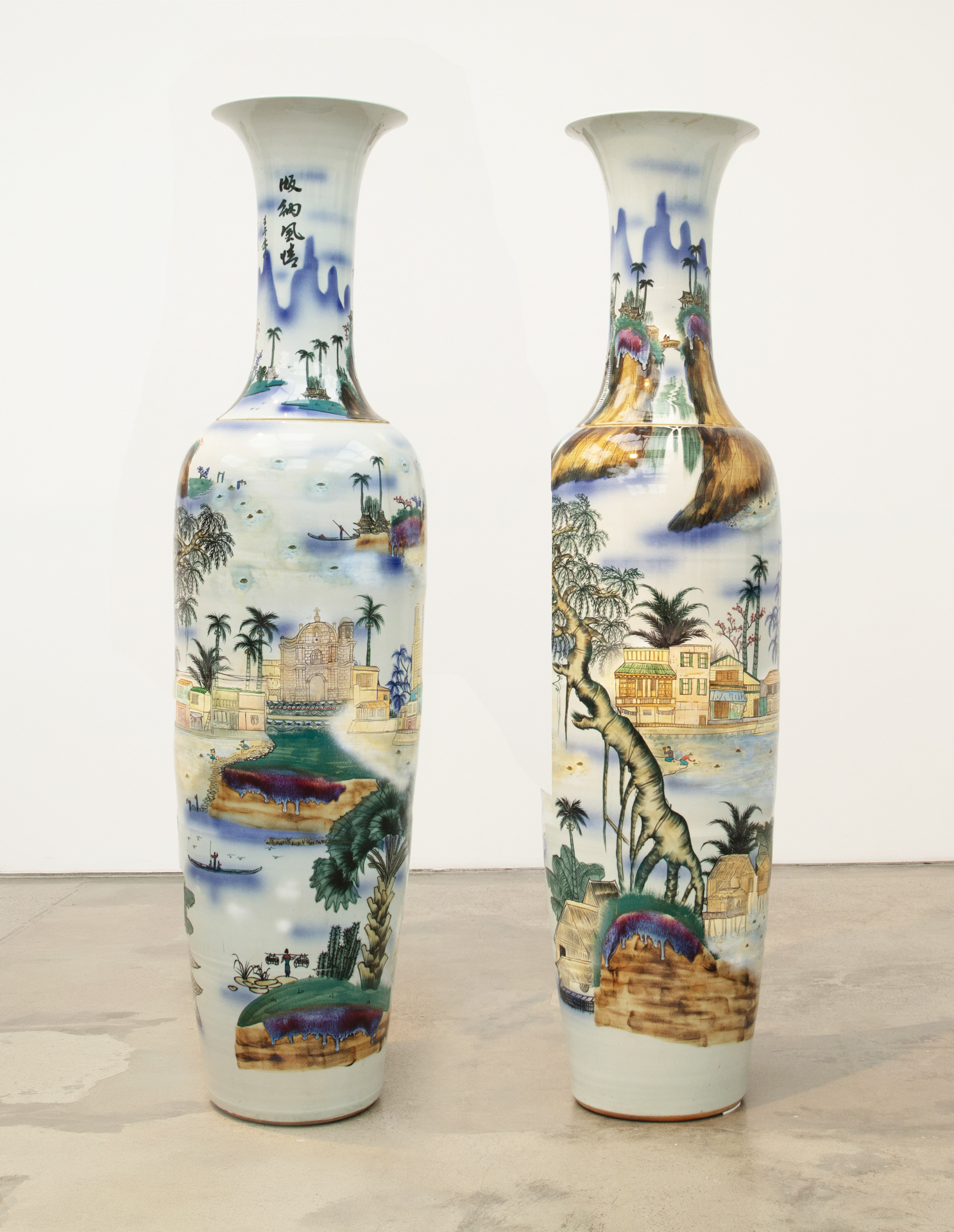
    The exhibition’s different histories of movement, encounter, and transformation come together in two immense vases depicting fantastical landscapes of Yunnan into which Navarroza inserts recognizable fragments of Manila. On one appears Binondo, identifiable through the octagonal bell tower of its church and the surrounding shophouses; on the other, old and new Makati coexist, the seventeenth-century Church of Saints Peter and Paul set against the high-rises of the Central Business District. The Pasig River winds through both landscapes, carrying small cups that recall the gathering at the Orchid Pavilion.

    For Navarroza, “the cups that floated from the Orchid Pavilion are the many boats that traversed our archipelago, through the centuries and we have drunk from it and at each turn, created something out of it that became uniquely our own.”

    It is this process of continual transformation that runs through The Orchid Pavilion. The histories Navarroza invokes do not resolve into discrete origins or influences. Like the objects that travelled across seas and acquired new uses, meanings, and associations along the way, they have been absorbed, translated, and remade. What emerges is less a search for where Filipino culture begins than an acknowledgement of the many encounters through which it has continually become its own.

    Words by Yael Buencamino

    Wawi Navarroza is a Filipina lens-based artist recognized for her vibrant large-format photographic tableaus and self-portraits, which comment on the plurality of identity, photography, and place.

    Informed by material history, post-colonial dialogue, globalization, and her experiences as transnational, female, Southeast Asian, and Filipina, Navarroza creates multi-layered in-studio bricolage with camera and lighting techniques that unapologetically reclaim the heritage of polychrome in Oriental art. Navarroza's visual language emphasizes the often-overlooked power of symbolic allegory and folk memory through her rich lexicon of crisscrossing cultural references and riddles. Her work serves as a testament to the various facets and stages of the woman's narrative, underlining woman as world-maker and active participant in history. She champions textiles, interiors, and "women's work" in her materials and uses her own corporeal body as an artistic medium, underlining sovereign self-representation and agency through self-portraits—revealing the female artist not just behind the camera, but bravely in front of it.

    With more than two decades of art practice primarily using photography, she has witnessed—not once, but several times—the paradigm shifts of this ever-changing field, with its triumphs, challenges, and difficult positions in contemporary art discourse. Alongside this, mirrored by a body of work that charts a call-and-response to the artist's own crests and troughs, Navarroza chose to abide by the medium and transform with it.

    Recently, she received the prestigious Alexander Tutsek Stiftung Photography Grant (2025) and was Runner-up for the Objectifs Singapore Women in Focus Art Awards (2025). Other awards include the Asian Cultural Council Fellowship Grant, New York; the Lucas Artists Fellowship Award for Visual Arts, San Francisco; and national awards such as the Cultural Center of the Philippines' Thirteen Artists Award and the Ateneo Art Awards, as well as a nomination for the Leica Oskar Barnack Award.

    Navarroza's works are in the collections of The Getty Museum (Los Angeles), the International Center of Photography (New York), the Lumi Photography Museum (Finland), the Central Bank of the Philippines, the Metropolitan Museum of the Philippines, the Ateneo Art Gallery, Menarco Vertical Museum, Monsoon Southeast Asia, the Ayala Art Collection, and the Akeroyd Collection (HK/UK).

    She has been exhibited internationally in museums including the National Gallery of Singapore, the National Museum of Fine Arts (Taiwan), the Fries Museum of Contemporary Art & Museum Belvedere (Netherlands), and the Danubiana Museum (Slovakia), as well as in galleries in the USA, Australia, Japan, Malaysia, Singapore, London, Spain, Italy, and Russia. Her art has been surveyed in books such as Photography Today (Phaidon), Contemporary Photography in Asia (Prestel), and Photography in Southeast Asia by Zhuang Wubin (NUS Press).

    Navarroza is also a staunch advocate for photographic education and visual literacy. She has served as lecturer, educator, masterclass workshop teacher, and juror for several national awards and international festivals. She is the founder of THOUSANDFOLD, Manila's first photobook library and a platform for contemporary photography education and support for emerging Filipino photographic artists (2015–2020), and a co-founder of FOTOMOTO PH, a non-profit for the promotion and exhibition of Philippine photography (2021–ongoing). She has published two artist books and is often invited to speak on photography and visual culture. Navarroza is a graduate of De La Salle University Manila, with continuing education at the International Center of Photography (ICP), New York, and a Master's in Contemporary Photography from Istituto Europeo di Design (IED), Madrid.

    Wawi Navarroza is currently based in Manila, Philippines; previously in Madrid, Spain, and İstanbul, Türkiye. She is represented by Silverlens Gallery (Manila/New York) and Kristin Hjellegjerde Gallery (London/Berlin/Palm Beach).

“When future generations look back to my time, it will probably be similar to how I now think of the past.”

Wang Xizhi
Preface to the Poems Composed at the Orchid Pavilion (Lantingji Xu)
353 CE

The Orchid Pavilion, the first of Navarroza’s trilogy of exhibitions, considers the exchanges and acculturations that accompanied the movement of people and objects through the Philippines before and during the centuries of the Manila Galleon trade. It focuses on the country’s pan-Asian heritage and, more specifically, on the longstanding Chinese presence woven into Filipino culture and identity.

Taking literature and poetry as points of departure, Navarroza turns to the Philippines’ layered past, looking beyond its broad strokes—heroes, events, and unified narratives—to the details within them. She approaches history through a sensorial lens, conjuring the atmosphere of Manila as a bustling, cosmopolitan entrepôt where disparate people, languages, objects, and traditions converged.

Among the material traces of these exchanges, few are as ubiquitous as blue-and-white ceramics. Developed in China and present-day Iraq from around the ninth century, they circulated widely across the world. In Ten Thousand Things (Blue and White, Self-Portrait with Promise Piece), Navarroza is surrounded by vessels in a myriad of forms, while carrying their contemporary paper-plate imitations. Their persistence across regions is echoed by fabrics from different cultures in the same hues—Yakan weaves, cotton batik, and lace—bringing together materials whose shared palette belies their disparate origins.

While ceramics bear their histories of circulation visibly, other forms of cultural exchange are less obvious. Catholic devotional statues are commonly understood as a legacy of Spanish colonization, yet scholars have argued that Marian images in the Philippines were carved by Chinese craftsmen who drew upon representations of Buddhist deities as models. Devotion (Syncretismo: La Bruja III) points to these influences and the different traditions that have come together in objects we now think of as Filipino.

This movement between cultural languages finds another form in Triple-Tongued (The Artist as Scholar, Self-Portrait as Ladino). Like the ladinos of the Spanish colonial period, who moved between the language of the colonizer and their native tongues, Navarroza moves between different systems of knowledge and expression. Of all the portraits in the exhibition, this is perhaps the one in which she most explicitly reveals herself. The artist appears as scholar and polyglot—Navarroza herself speaks six languages—an intellectual omnivore drawing from different worlds of language and culture. In assuming the figure of the ladino, she imagines herself as part of a tradition of those who moved between languages and cultures, carrying cultural understanding from one to another.

In Ilustrada (Self-Portrait after Justiniano Asuncion’s “Portrait of Filomena Asuncion Villafranca”), Navarroza assumes the pose of the earlier portrait but introduces contemporary points of reference that suggest a fuller personality than the historical image allows us to see. Asuncion’s portrait tells us how a woman of her class was represented, but little about who she might have been. Navarroza’s pictures do not attempt to illustrate history. Instead, they propose ways of imagining it.

Art history and literature feed Navarroza’s aesthetic universe, their imagery absorbed and reimagined within her own. Double-Naveled (The Filipino & the Foreign, Self-Portrait) takes its title from Nick Joaquin’s classic novel, with its questions of national identity and received history, while returning to a device familiar in Navarroza’s work: two sides of her persona confronting one another. The figures share a divan and seemingly inspect each other, though each is looking into a mirror held between them. Other mirrors scattered across the floor return unexpected fragments rather than what lies before them. Navarroza has collaged these mirrors into the photograph, deliberately leaving visible the sharp edges of the pieces she has cut and pasted. The technique disturbs the perfection of the photograph while calling into question what Navarroza herself sees in the mirror she holds, reflecting the complicated process of exploring identity and the entangled histories that have shaped it.

In One Hundred Lives (Self-Portrait as a Phoenix: Fenghuang), Navarroza presents the feminine triumphant. She sits stoic and self-possessed atop a mountain of fabric, balancing a precious blue-and-white vase on one knee. There is something protective and defiant in the gesture, a sense that she can safeguard that which matters. But the work moves beyond the triumph of the individual. Navarroza wears Patricia Eustaquio’s All Dressed Up, a dress composed of one hundred garments sourced from ukay-ukay, which for Navarroza signifies “the many lives and roles women take on all at once,” its fragments becoming pieces in the fabric of women’s stories. That the dress is itself the work of another woman artist, lent by Eustaquio for Navarroza to wear, introduces another form of exchange: one grounded in the support and generosity between women. Here, as throughout the large portraits in the exhibition, fabrics spill beyond the photograph and onto its frame, extending the image into the physical space of the work and emphasizing its object-ness.

Although Navarroza appears throughout The Orchid Pavilion, these are not self-portraits in the traditional sense. She describes using her body as a medium, “like a babaylan,” invoking the precolonial Philippine spiritual figure. Her body remains constant while costume, gesture, and attributes change, allowing her to inhabit different personas within the photographs. The more frequently Navarroza appears, the less the photographs seem to be about Navarroza herself.

Navarroza’s assumption of different identities takes a more critical turn in the Plural and Polymodal Riddle series, where she questions the categories that continue to be imposed upon people. Drawing on colonial visual typologies—from the Boxer Codex to tipos del país and costumbrista painting—she poses with attributes associated with each label, their classifications emblazoned across pageant-style sashes. The works challenge labels in which the very people they are meant to define may not recognize themselves.

The exhibition’s different histories of movement, encounter, and transformation come together in two immense vases depicting fantastical landscapes of Yunnan into which Navarroza inserts recognizable fragments of Manila. On one appears Binondo, identifiable through the octagonal bell tower of its church and the surrounding shophouses; on the other, old and new Makati coexist, the seventeenth-century Church of Saints Peter and Paul set against the high-rises of the Central Business District. The Pasig River winds through both landscapes, carrying small cups that recall the gathering at the Orchid Pavilion.

For Navarroza, “the cups that floated from the Orchid Pavilion are the many boats that traversed our archipelago, through the centuries and we have drunk from it and at each turn, created something out of it that became uniquely our own.”

It is this process of continual transformation that runs through The Orchid Pavilion. The histories Navarroza invokes do not resolve into discrete origins or influences. Like the objects that travelled across seas and acquired new uses, meanings, and associations along the way, they have been absorbed, translated, and remade. What emerges is less a search for where Filipino culture begins than an acknowledgement of the many encounters through which it has continually become its own.

Words by Yael Buencamino

Wawi Navarroza is a Filipina lens-based artist recognized for her vibrant large-format photographic tableaus and self-portraits, which comment on the plurality of identity, photography, and place.

Informed by material history, post-colonial dialogue, globalization, and her experiences as transnational, female, Southeast Asian, and Filipina, Navarroza creates multi-layered in-studio bricolage with camera and lighting techniques that unapologetically reclaim the heritage of polychrome in Oriental art. Navarroza's visual language emphasizes the often-overlooked power of symbolic allegory and folk memory through her rich lexicon of crisscrossing cultural references and riddles. Her work serves as a testament to the various facets and stages of the woman's narrative, underlining woman as world-maker and active participant in history. She champions textiles, interiors, and "women's work" in her materials and uses her own corporeal body as an artistic medium, underlining sovereign self-representation and agency through self-portraits—revealing the female artist not just behind the camera, but bravely in front of it.

With more than two decades of art practice primarily using photography, she has witnessed—not once, but several times—the paradigm shifts of this ever-changing field, with its triumphs, challenges, and difficult positions in contemporary art discourse. Alongside this, mirrored by a body of work that charts a call-and-response to the artist's own crests and troughs, Navarroza chose to abide by the medium and transform with it.

Recently, she received the prestigious Alexander Tutsek Stiftung Photography Grant (2025) and was Runner-up for the Objectifs Singapore Women in Focus Art Awards (2025). Other awards include the Asian Cultural Council Fellowship Grant, New York; the Lucas Artists Fellowship Award for Visual Arts, San Francisco; and national awards such as the Cultural Center of the Philippines' Thirteen Artists Award and the Ateneo Art Awards, as well as a nomination for the Leica Oskar Barnack Award.

Navarroza's works are in the collections of The Getty Museum (Los Angeles), the International Center of Photography (New York), the Lumi Photography Museum (Finland), the Central Bank of the Philippines, the Metropolitan Museum of the Philippines, the Ateneo Art Gallery, Menarco Vertical Museum, Monsoon Southeast Asia, the Ayala Art Collection, and the Akeroyd Collection (HK/UK).

She has been exhibited internationally in museums including the National Gallery of Singapore, the National Museum of Fine Arts (Taiwan), the Fries Museum of Contemporary Art & Museum Belvedere (Netherlands), and the Danubiana Museum (Slovakia), as well as in galleries in the USA, Australia, Japan, Malaysia, Singapore, London, Spain, Italy, and Russia. Her art has been surveyed in books such as Photography Today (Phaidon), Contemporary Photography in Asia (Prestel), and Photography in Southeast Asia by Zhuang Wubin (NUS Press).

Navarroza is also a staunch advocate for photographic education and visual literacy. She has served as lecturer, educator, masterclass workshop teacher, and juror for several national awards and international festivals. She is the founder of THOUSANDFOLD, Manila's first photobook library and a platform for contemporary photography education and support for emerging Filipino photographic artists (2015–2020), and a co-founder of FOTOMOTO PH, a non-profit for the promotion and exhibition of Philippine photography (2021–ongoing). She has published two artist books and is often invited to speak on photography and visual culture. Navarroza is a graduate of De La Salle University Manila, with continuing education at the International Center of Photography (ICP), New York, and a Master's in Contemporary Photography from Istituto Europeo di Design (IED), Madrid.

Wawi Navarroza is currently based in Manila, Philippines; previously in Madrid, Spain, and İstanbul, Türkiye. She is represented by Silverlens Gallery (Manila/New York) and Kristin Hjellegjerde Gallery (London/Berlin/Palm Beach).

Works
Wawi Navarroza
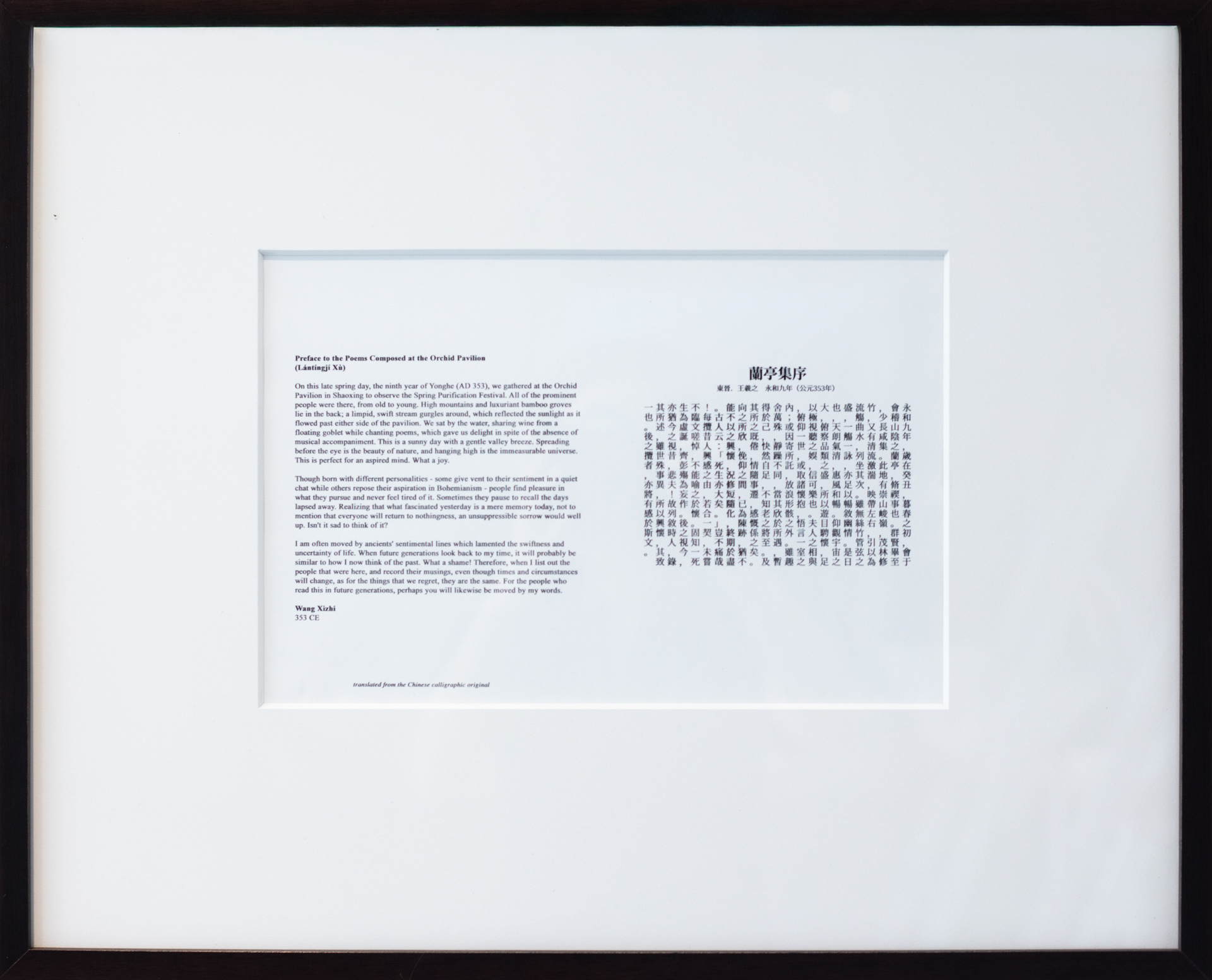
兰亭序 (Lanting Xu), "Orchid Pavilion Preface," by Wang Xizhi
353 CE, 353 (4th Century)
17896
2
archival pigment ink on Hahnemühle Rice Paper
8h x 12w in 20.3h x 30.5w cm (artwork) 16.93h x 20.87w x 1.18d in 43h x 53w x 3d cm (framed)
-1
0.00
PHP
0
Details
Wawi Navarroza
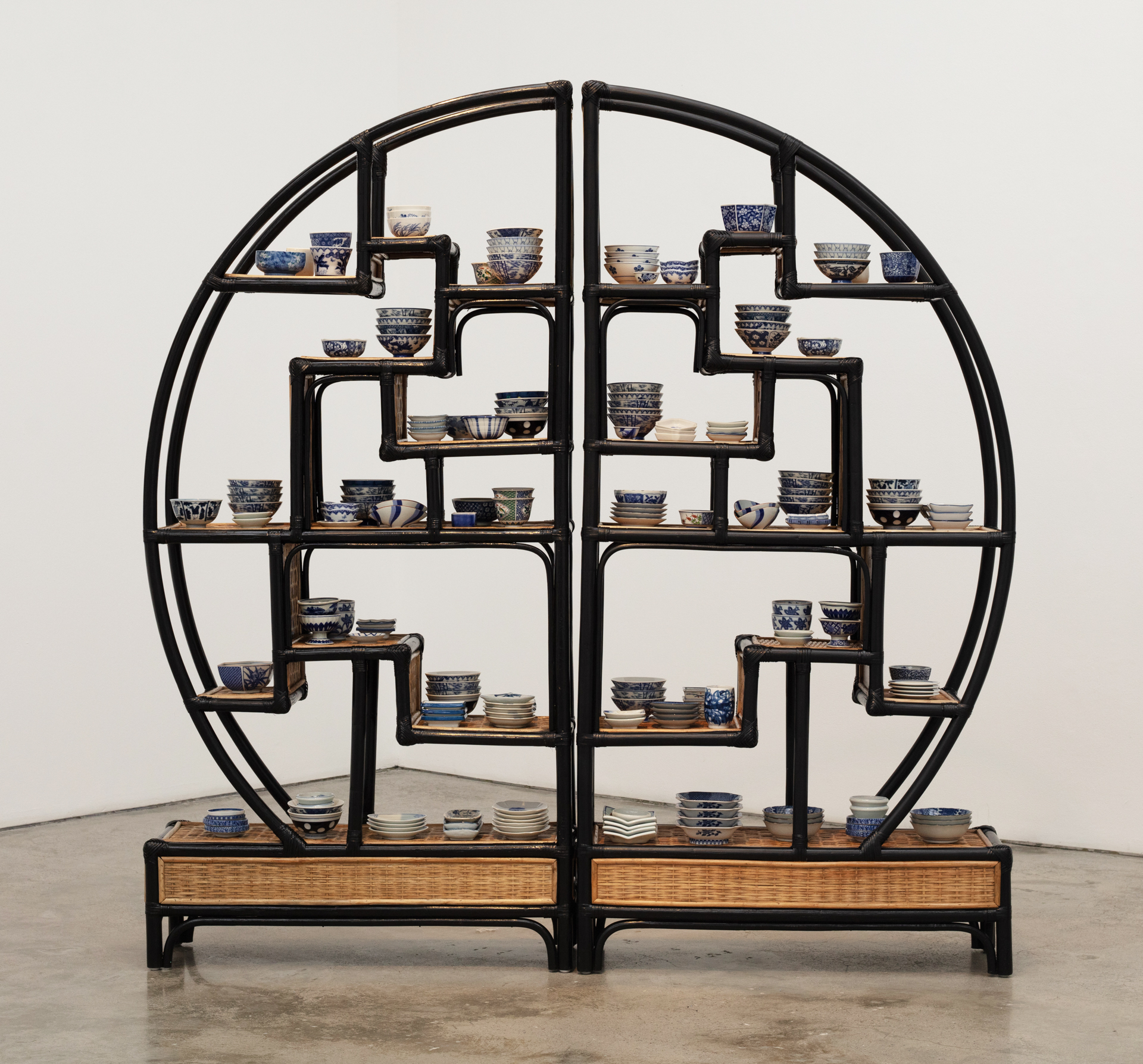
Moon Shelf (Blue & White Cups, Rice Bowls & Soy Dishes, Japanese surplus)
2026
17900
2
Oriental style moon shelf made out of Philippine rattan, black ducco finish with closed-weave shelving; various blue and white ceramic bowls from surplus shops around the Philippines (Installation)
72h x 70.47w x 11.81d in 183h x 179w x 30d cm
-1
0.00
PHP
0
Details
Wawi Navarroza
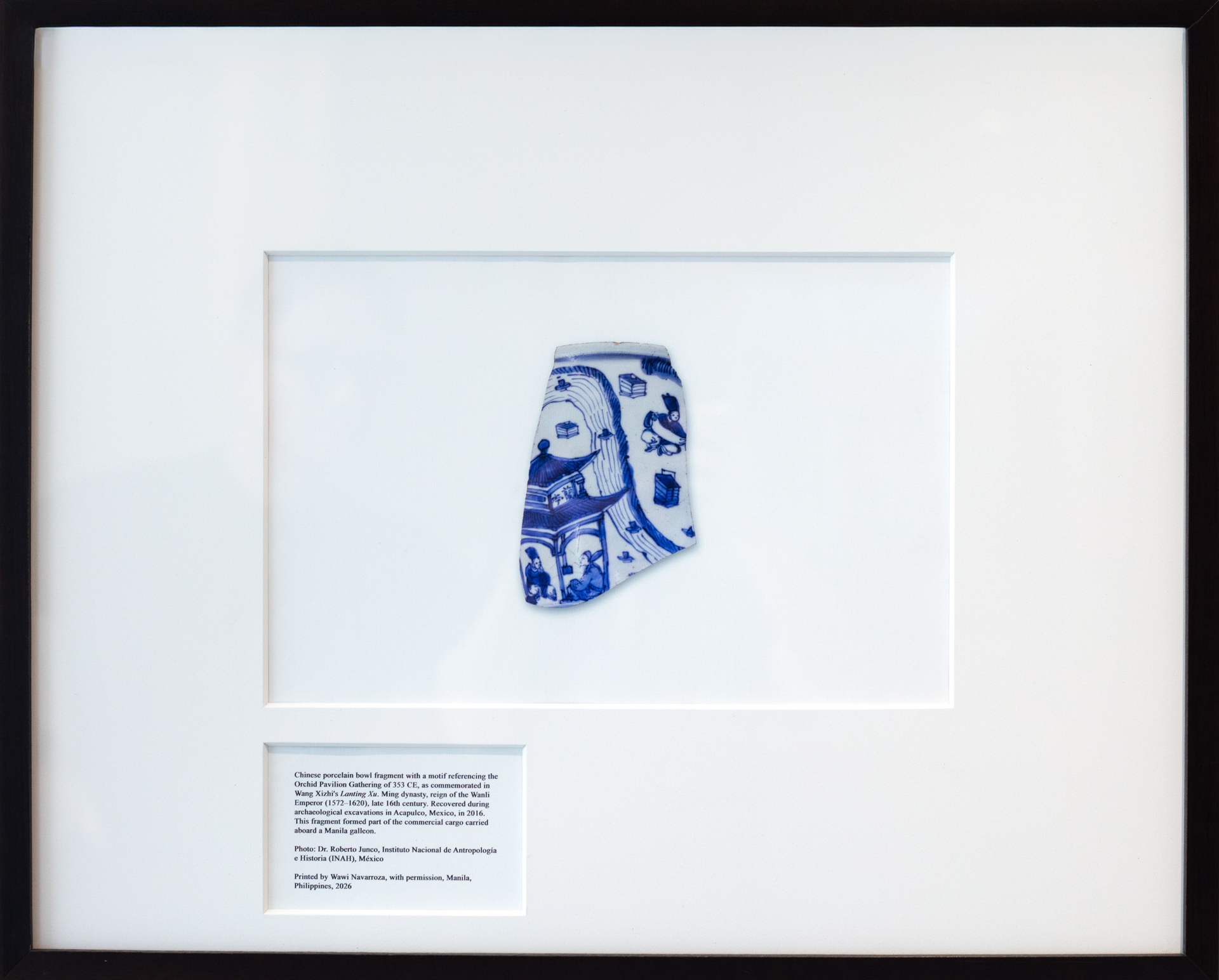
Artifact, 16th century Ming porcelain fragment with Orchid Pavilion motif
2016/2026
17895
2
archival pigment ink on Hahnemühle Rice Paper
8h x 12w in 20.3h x 30.5w cm (artwork) 16.93h x 20.87w x 1.18d in 43h x 53w x 3d cm (framed)
-1
0.00
PHP
0
Details
Wawi Navarroza
Ilustrada (Self-Portrait after Justiniano Asuncion "Portrait of Filomena Asuncion Villafranca" c. 1850s–1860s)
2026
17894
2
archival pigment ink on Hahnemühle Photo Rag® Pearl, cold-mounted on acid-free aluminum, with artist frame
39.37h x 31.5w in 100h x 80w cm (artwork) 46.85h x 38.86w x 1.85d in 119h x 98.7w x 4.7d cm (framed)
-1
0.00
PHP
0
Edition of 5 plus 1 artist's proof
Details
Wawi Navarroza
Ten Thousand Things (Blue & White, Self-Portrait with Promise Piece)
2026
17884
2
archival pigment ink on Hahnemühle Photo Rag® Pearl, cold-mounted on acid-free aluminum, with artist frame
39.76h x 53.15w in 101h x 135w cm (artwork) 47.32h x 60.83w x 1.85d in 120.20h x 154.5w x 4.7d cm (framed)
-1
0.00
PHP
0
Edition of 5 plus 1 artist's proof (#1/5)
Details
Wawi Navarroza
Devotion (Syncretismo/La Bruja III, Self-Portrait)
2026
17890
2
archival pigment ink on Hahnemühle Photo Rag® Baryta, cold-mounted on acid-free aluminum, with artist frame
53.15h x 39.76w in 135h x 101w cm (artwork) 61.02h x 47.52w x 1.89d in 155h x 120.7w x 4.8d cm (framed)
-1
0.00
PHP
0
Edition of 5 plus 1 artist's proof
Details
Wawi Navarroza
One Hundred Lives (Self-Portrait as Phoenix/ Fenghuang 鳳凰)
2026
17892
2
archival pigment ink on Hahnemühle Photo Rag® Pearl, cold-mounted on acid-free aluminum, with artist frame
53.15h x 39.76w in 135h x 101w cm (artwork) 61.02h x 47.52w x 1.89d in 155h x 120.7w x 4.8d cm (framed)
-1
0.00
PHP
0
Edition of 5 plus 1 artist's proof
Details
Wawi Navarroza
Double-Naveled (The Filipino & the Foreign, Self-Portrait)
2026
17893
2
archival pigment ink on Hahnemühle Photo Rag® Baryta, cold-mounted on acid-free aluminum, with artist frame
39.76h x 53.15w in 101h x 135w cm (artwork) 47.56h x 61.02w x 1.97d in 120.8h x 155w x 5d cm (framed)
-1
0.00
PHP
0
Edition of 5 plus 1 artist's proof
Details
Wawi Navarroza
Triple-Tongued (The Artist as Scholar, Self-Portrait as Ladino)
2026 archival pigment ink on Hahnemühle Photo Rag® Pearl, cold-mounted on acid-free aluminum, with artist frame
17891
2
archival pigment ink on Hahnemühle Photo Rag® Pearl, cold-mounted on acid-free aluminum, with artist frame
39.37h x 31.5w in 100h x 80w cm (artwork) 46.85h x 38.86w x 1.85d in 119h x 98.7w x 4.7d cm (framed)
-1
0.00
PHP
0
Edition of 5 plus 1 artist's proof
Details
Wawi Navarroza
Plural & Polymodal Riddle - South East Asian (Self-Portrait with Beeswax & Keris)
2026
17886
2
archival pigment ink on Hahnemühle Photo Rag® Pearl, cold-mounted on acid-free aluminum, with artist frame
27.56h x 19.69w in 70h x 50w cm (artwork) 28.74h x 20.75w x 1.57d in 73h x 52.7w x 4d cm (framed)
-1
0.00
PHP
0
Edition of 10 plus 1 artist's proof (#1/10)
Details
Wawi Navarroza
Plural & Polymodal Riddle - Pacific Islander (Self-Portrait with Coconut & Nautilus)
2026
17887
2
archival pigment ink on Hahnemühle Photo Rag® Pearl, cold-mounted on acid-free aluminum, with artist frame
27.56h x 19.69w in 70h x 50w cm (artwork) 28.74h x 20.75w x 1.57d in 73h x 52.7w x 4d cm (framed)
-1
0.00
PHP
0
Edition of 10 plus 1 artist's proof (#1/10)
Details
Wawi Navarroza
Plural & Polymodal Riddle - Austronesian (Self-Portrait with Salt & Vinegar)
2026
17885
2
archival pigment ink on Hahnemühle Photo Rag® Pearl, cold-mounted on acid-free aluminum, with artist frame
27.56h x 19.69w in 70h x 50w cm (artwork) 28.74h x 20.75w x 1.57d in 73h x 52.7w x 4d cm (framed)
-1
0.00
PHP
0
Edition of 10 plus 1 artist's proof (#1/10)
Details
Wawi Navarroza
Plural & Polymodal Riddle - Other
2026
17889
2
archival pigment ink on Hahnemühle Photo Rag® Pearl, cold-mounted on acid-free aluminum, with artist frame
27.56h x 19.69w in 70h x 50w cm (artwork) 28.74h x 20.75w x 1.57d in 73h x 52.7w x 4d cm (framed)
-1
0.00
PHP
0
Edition of 10 plus 1 artist's proof (#1/10)
Details
Wawi Navarroza
The Orchid Pavilion (in the land of the Tropical Gothic), Makati and Binondo
2026
17897
2
ceramic oriental jars made in Jingdezhen, with handpainted intervention, acrylic on glaze
Approx. 87.60h x 21.65w in 222.5h x 55w cm (each)
-1
0.00
PHP
0
Edition of 1 (unique)
Details
Wawi Navarroza
Plural & Polymodal Riddle - Self
2026
17888
2
archival pigment ink on Hahnemühle Photo Rag® Pearl, cold-mounted on acid-free aluminum, with artist frame
27.56h x 19.69w in 70h x 50w cm (artwork) 28.74h x 20.75w x 1.57d in 73h x 52.7w x 4d cm (framed)
-1
0.00
PHP
0
Edition of 10 plus 1 artist's proof (#1/10)
Details

Installation Views

PHA+PHN0cm9uZz5TSUxWRVJMRU5TPC9zdHJvbmc+IGlzIGNvbW1pdHRlZCB0byBwcm90ZWN0aW5nIHlvdXIgcHJpdmFjeS4gSW4gY29tcGxpYW5jZSB3aXRoIHRoZSBQaGlsaXBwaW5lIFJlcHVibGljIEFjdCwgTm8uIDEwMTczIGJldHRlciBrbm93biBhcyB0aGUgMjAxMiBEYXRhIFByaXZhY3kgQWN0LCB3ZSBjYW4gb25seSB1c2UgdGhlIGluZm9ybWF0aW9uIHRoYXQgd2Ugb2J0YWluIGFib3V0IHlvdSBsYXdmdWxseS4gV2UgbWF5IGNvbGxlY3QgcGVyc29uYWwgaW5mb3JtYXRpb24gYWJvdXQgeW91IHdoZW4geW91IHNpZ24gdXAgZm9yIG91ciBuZXdzbGV0dGVyIG9yIGNvbnRhY3QgdXMgd2l0aCBhbiBpbnF1aXJ5LjwvcD4KPHA+VGhlIHR5cGUgb2YgaW5mb3JtYXRpb24gd2UgbWF5IGNvbGxlY3QgaW5jbHVkZXMgeW91ciA8c3Ryb25nPk5hbWU8L3N0cm9uZz4sIDxzdHJvbmc+RW1haWw8L3N0cm9uZz4sIGFuZCA8c3Ryb25nPkNvbnRhY3QgTnVtYmVyPC9zdHJvbmc+LjwvcD4KPHA+V2UgbWF5IGNvbGxlY3QgcGF5bWVudCBpbmZvcm1hdGlvbiBmcm9tIHlvdSB0byBmdWxmaWxsIHRyYW5zYWN0aW9ucy4gVG8gcHJvY2VzcyBwYXltZW50cywgd2UgbWF5IGNvbGxlY3QgeW91ciBjcmVkaXQgY2FyZCBhbmQgYmFuayBhY2NvdW50IGRldGFpbHMuIFRoaXMgaW5mb3JtYXRpb24gbWF5IGJlIHNoYXJlZCB3aXRoIHRoaXJkIHBhcnR5IHBheW1lbnQgcHJvY2Vzc2luZyBzZXJ2aWNlcy48L3A+CjxwPlRvIGRlbGl2ZXIgeW91ciBwdXJjaGFzZSwgd2UgbWF5IHByb3ZpZGUgeW91ciBwZXJzb25hbCBpbmZvcm1hdGlvbiB0byB0aGlyZC1wYXJ0eSBsb2dpc3RpY3MgY29tcGFuaWVzIHdobyBhc3Npc3QgdXMgd2l0aCBvdXIgZGVsaXZlcmllcyBhbmQgc2hpcG1lbnRzLjwvcD4KPHA+VGhlIHBlcnNvbmFsIGluZm9ybWF0aW9uIHdoaWNoIHdlIGhvbGQgd2lsbCBiZSBoZWxkIHNlY3VyZWx5IGluIGFjY29yZGFuY2Ugd2l0aCBvdXIgaW50ZXJuYWwgc2VjdXJpdHkgcG9saWN5LiBXZSB3aWxsIG5ldmVyIGNvbGxlY3QgaW5mb3JtYXRpb24gYWJvdXQgeW91IHdpdGhvdXQgeW91ciBleHBsaWNpdCBjb25zZW50LjwvcD4KPHA+VGhlIGluZm9ybWF0aW9uIHdlIHN0b3JlIHdpbGwgYmUgYWNjdXJhdGUgYW5kIHVwIHRvIGRhdGUuIFlvdSBjYW4gY2hlY2sgdGhlIGluZm9ybWF0aW9uIHRoYXQgd2UgaG9sZCBhYm91dCB5b3UgYnkgZW1haWxpbmcgdXMuIElmIHlvdSBmaW5kIHRoYXQgdGhlcmUgYXJlIGFueSBpbmFjY3VyYWNpZXMsIHdlIHdpbGwgZGVsZXRlIG9yIGNvcnJlY3QgaXQgcHJvbXB0bHkuPC9wPgo8cD5XZSBtYXkgdXNlIHRlY2hub2xvZ3kgdG8gdHJhY2sgdGhlIHBhdHRlcm5zIG9mIGJlaGF2aW9yIG9mIHZpc2l0b3JzIHRvIG91ciB3ZWJzaXRlLiBUaGlzIG1heSBpbmNsdWRlIHVzaW5nIGEgImNvb2tpZSIgc3RvcmVkIG9uIHlvdXIgYnJvd3NlciB3aGljaCB5b3UgY2FuIHVzdWFsbHkgbW9kaWZ5IHRocm91Z2ggeW91ciBicm93c2VyIHRvIHByZXZlbnQgdGhpcyBmcm9tIGhhcHBlbmluZy48L3A+CjxwPldlIHdpbGwgcmV0YWluIHlvdXIgcGVyc29uYWwgaW5mb3JtYXRpb24gb25seSB3aGlsZSB3ZSBuZWVkIGl0IGZvciB0aGUgcmVhc29ucyBzdGF0ZWQgYWJvdmUgb3IgdW50aWwgeW91IHJlcXVlc3QgdGhhdCB3ZSBkZWxldGUgaXQgb24gb3VyIHJlY29yZHMuPC9wPgo8cD5JZiB5b3UgaGF2ZSBhbnkgcXVlc3Rpb25zIG9yIGNvbW1lbnRzIGFib3V0IG91ciBwcml2YWN5LCBwbGVhc2UgY29udGFjdCB1cyBhdCA8YSBocmVmPSJtYWlsdG86aW5xdWlyeUBzaWx2ZXJsZW5zZ2FsbGVyaWVzLmNvbSI+aW5xdWlyeUBzaWx2ZXJsZW5zZ2FsbGVyaWVzLmNvbTwvYT48L3A+
R2FpbiBhY2Nlc3MgdG8gZXhjbHVzaXZlIGdhbGxlcnkgaW5mb3JtYXRpb24sIGxhdGVzdCBleGhpYml0aW9ucywgPGJyIC8+CmFuZCBhcnRpc3QgdXBkYXRlcyBieSBzaWduaW5nIHVwIGZvciBvdXIgbmV3c2xldHRlciBiZWxvdy4=