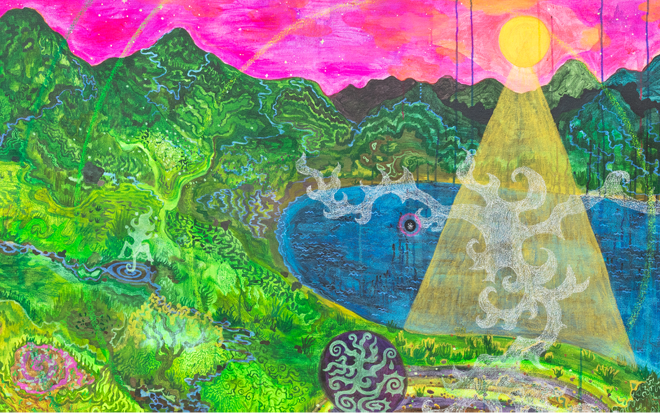
mirrors, merging
Catalina Africa
Silverlens, Manila
About

mirrors, merging is Catalina Africa’s new body of paintings that step into the innerscape of transitions. The world is seen and called anew, as Catalina precipitates otherworldly territories into works that test flow forms, dissolution, and the slow collapse of inner terrain into the landscape it mirrors. Five paintings in mirrors, merging are the steles that surround this mystery, registering a painter’s devotional process at thresholds of life and practice.
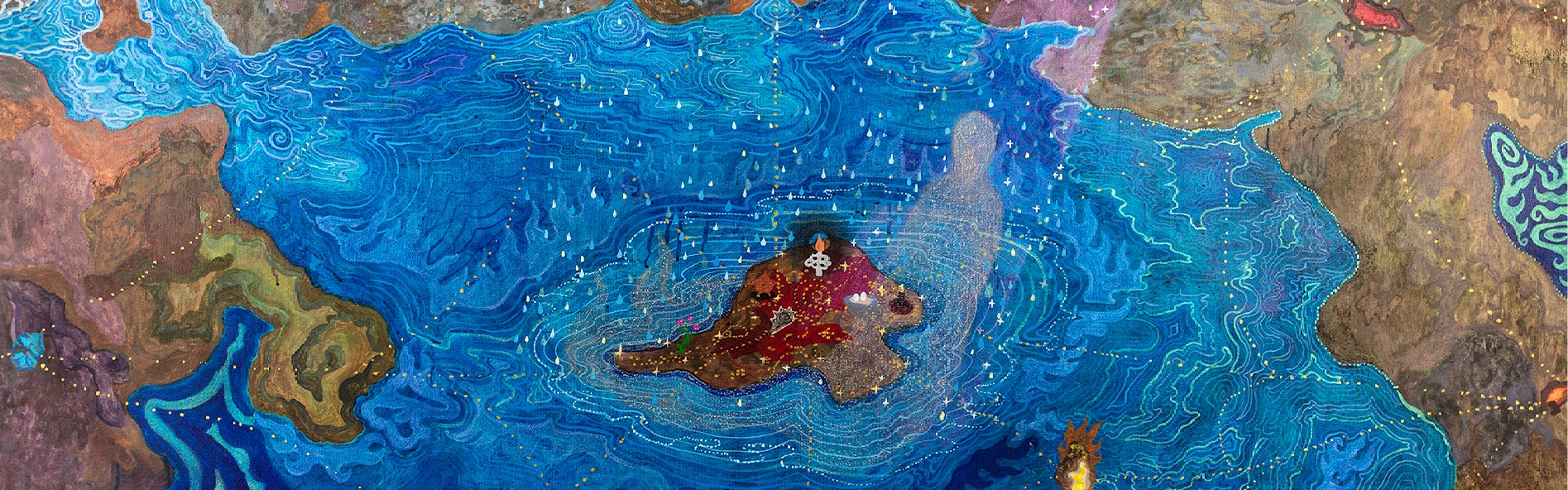
Catalina’s process across her five paintings moves like a single gesture stretched out over time, in which space is claimed, the ground is prepared, tributes are gathered, energy rises, and finally, there is release. Mirrors, Merging is a terrain of intention, where the cross-section of gestation lines the edges of emanation. An earth-hued field borders a figure in recline, the blue sphere around its form emitting a vapor-like wisp of a winged essence. Catalina stakes her center here, as if every inward turn of the self were also a turn toward the center of the inner world. The landscape unfurls in an atmospheric perspective, vibrating from the dense, multi-layered slice of soil. Amorphous contours cohabit the same landscape in tufts, warding each other as they go: ancestors, guides, and angels as Catalina imagines them. A process of consecration happens in Living Altars as water siphons into a sanctum and settles there into its own island, an altar formed by its own stillness. Having centered herself, Catalina gathers her correspondences: objects of favor laid around the body as the offering at the center.
Energy rises in Catalina’s painting-as-ritual in Perception Beyond Form and Collapsing Time, two canvases that share the symbol of a tree passed between them like a current. In Perception Beyond Form the tree is a totem, a spine of stacked faces, eyes, and lotus-forms rendered in luminous green, crowned by a sun and grounded by its mirror, a second sun glowing at the root. There is a reach toward this column from either side, as if the body itself were being assembled, or remembered, in parts. In Collapsing Time, a similar tree returns smaller, stiller. It is bare-branched, held inside a pale oval like a held breath at the center of a field on fire. Around it, the surface splits its temperature, hot reds and magentas curling into smoke-dark spirals on one side, cooling into teal and violet on the other, spectral grids and circles hovering faint beneath the color like a structure in between dissolution and formation. The tree, paltry but exact, is the one thing the painting has already decided. Flowform Study/ Inner Waters descends from a weathered terrain of ochre and moss, fissured by a dark spring that drips before it finds its channel. The water, once moving, becomes exact: a wide blue vessel cradles the three pairs of spirals, mirrored and stacked, each pair a chamber must turn through before it is allowed to fall further. A slender axis runs the full length of the form, the spine from which the spirals turn around, as if the whole structure were also quietly a body. This is the hydraulic figure-eight made visible: the actual architecture that orients water towards its own vitality, chamber by chamber, turn by turn. The cascade toward oxygenation, at this stage, aerates and releases the self.
mirrors, merging is Catalina reckoning with painting through the years. Archetypes of the elements continue to recur, but the landscapes find a turn of treatment, moving from the symbolic toward direct surrender to painting. In Shrine in the shape of a shadow, she articulates the hunch that while she calls the terrains that materialize in her works “inner landscapes,” they in fact resemble natural topographies. She tests this externalization further in Earth Body Bukid, drawing from her land cultivation and eco-spiritual work by sitting with the energetic auras of plants and feeling for the ecosystem’s transformation through landscape portraiture. There was an intentional internalization of her bukid: literal paths through the land become, in the sitting, passageways felt as thresholds, the larger forest ecosystem rending its own crossings legible to her.
Catalina starts mirrors, merging unmoored. If she was toeing the edges of the unfamiliar in her previous shows by mapping the boundaries to the unknown from the safety of the symbolic, then testing them against the land itself, now the unfamiliar has arrested her completely: not a portal she enters through painting, but a life she has had to surrender to outside it. In retrospect, there is the discovery that paintings, in their inevitable artifice of image-making, were always a matter of calculation: visual weight tempered surprise, and chance was an entity to be negotiated with in favor of likeness. Mastery, in this old accounting, meant control and meant getting the image of the experience right. But the unknown Catalina has surrendered to is larger than any image could hold, and painting has had to become something other than visualizing it. Painting is then both witness to a life becoming, and the tether holds her steady in this experience of suspension. Perhaps that is why water motifs are prevalent here in mirrors, merging. Water held in aerating vessels, still water in a cavern. There is transformation that happens in stillness.
In this time between an old self left behind and a self yet to arrive, painting becomes the one practice still tethered to who Catalina was. It is the steady thing to hold onto while everything else rearranges, and that is complicated as part of her remains out in the unknown. More a negotiation than an expression, painting is a site where parts of the self are laid out, sat with, taken into inventory, the way a swamp holds the vibrancy of life beneath a dense stillness. Slowly, without urgency to resolve, until what is being dealt with finally becomes legible. This is the deeper sense in which painting unfolds rite-like in mirrors, merging. Not the casting of a spell that bends the unknown to a desired shape, but the patient, messy work of holding everything until it can be known.
The five paintings in mirrors, merging are the container for the mystery of the unknown, which exists only when water sits still long enough to host life. Mirrors, Merging stakes a center that radiates to everywhere, Living Altars settles water into its own altar of stillness; the tree of Perception Beyond Form and Collapsing Time, holds the steady the field as the surroundings burn and cool; Flowform Study/ Inner Water makes visible the chambers through which a self must turn before it can fall further into what is becoming. Across them, inner terrain and the land outside it, the self that was and the self yet to arrive, prove to be the same threshold seen from different distances. The line between mirrors is never stable, and where mirrors merge is that which Catalina paints on.
Words by Siddharta Perez
Multi-disciplinary artist Catalina Africa (b. 1988, Manila, Philippines; lives and works in Baler, Philippines) considers shapeshifting her primary mode of expression. Working across painting, sound, sculpture, video, text, and performance, her work invokes the natural landscape, resembling spells, songs, prayers, and maps, as testimony to the Earth's mysteries. She cultivates a devotional practice to Spirit, transmuting Earth song in collaboration with the living land of Baler, where she lives with her husband and child.
Installation Views
Works
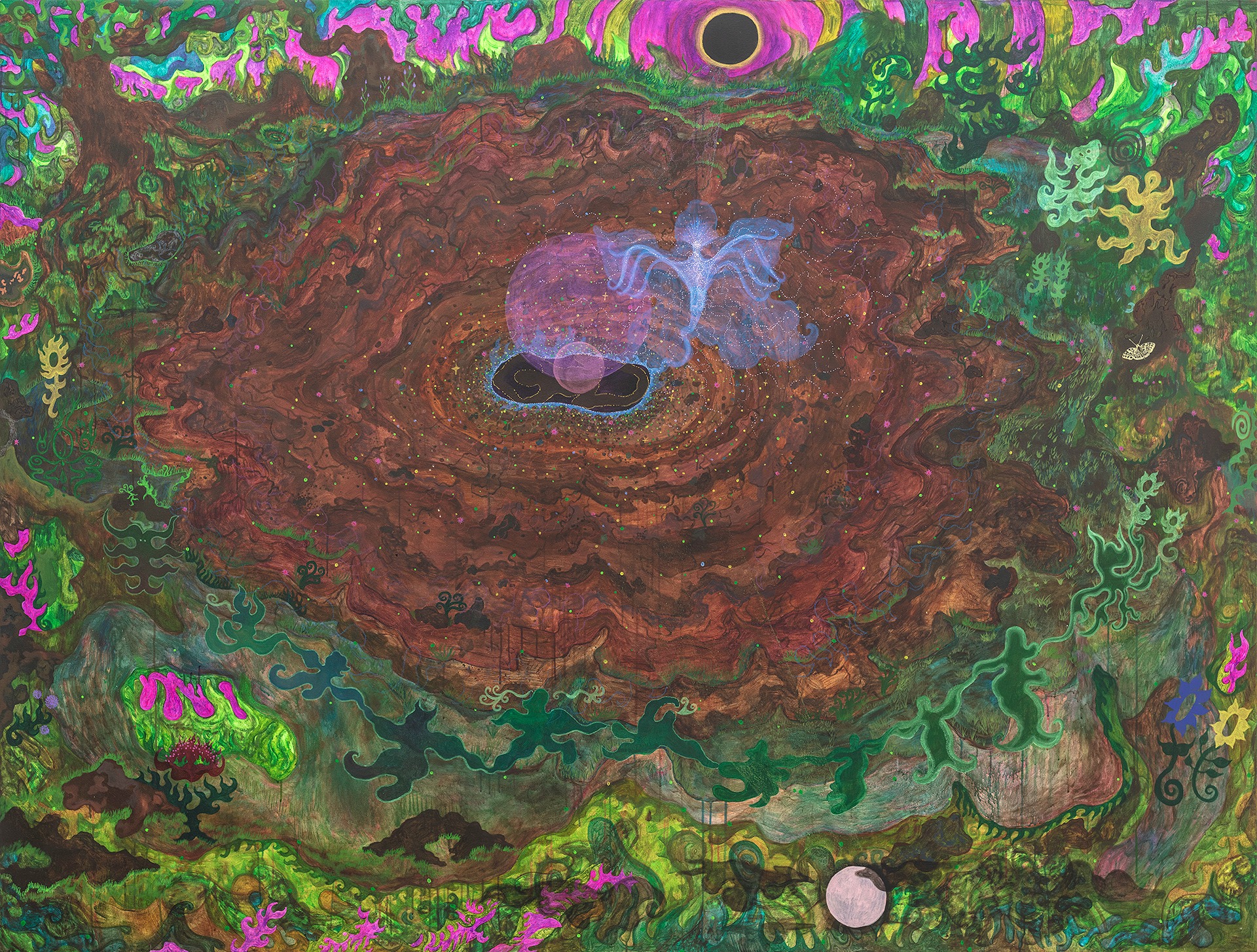
Although Africa positions herself at the center of the painting, she intentionally leaves the figure open enough to become universal. The work also depicts an inner landscape she returned to in moments that required fortitude, a dark but open field surrounded by "my angels, ancestors, guardians and guides." It was, she explains, "where I prayed."
During this period, Africa became increasingly aware of the relationship between artistic creation and childbirth. "Both require a surrender to the unknown, answering to Spirit, and becoming a channel for the universe to speak through." Through this parallel, the painting reflects her understanding of artistic practice as an act of bringing "forth form from the unseen realms."

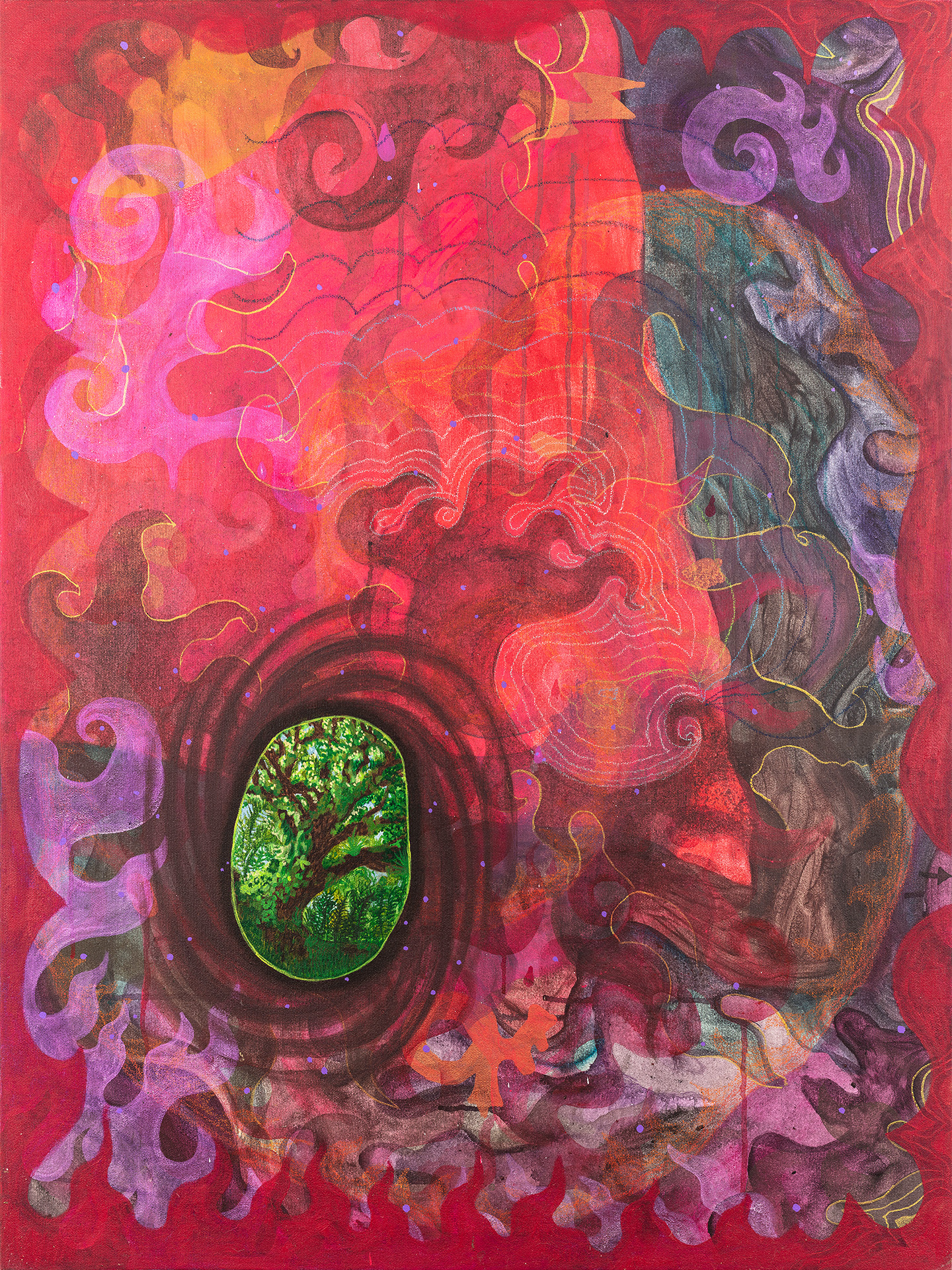
The tree recurs throughout the exhibition, including Mirrors, Merging and Living Altars, becoming a personal symbol that branches through the works. Africa describes it as "my inspiration, my guide, my teacher," rooted across different aspects of her life and practice. In this sense, painting becomes "a time machine," capable of collapsing time and creating passages between memory, ancestry, and the spiritual world.
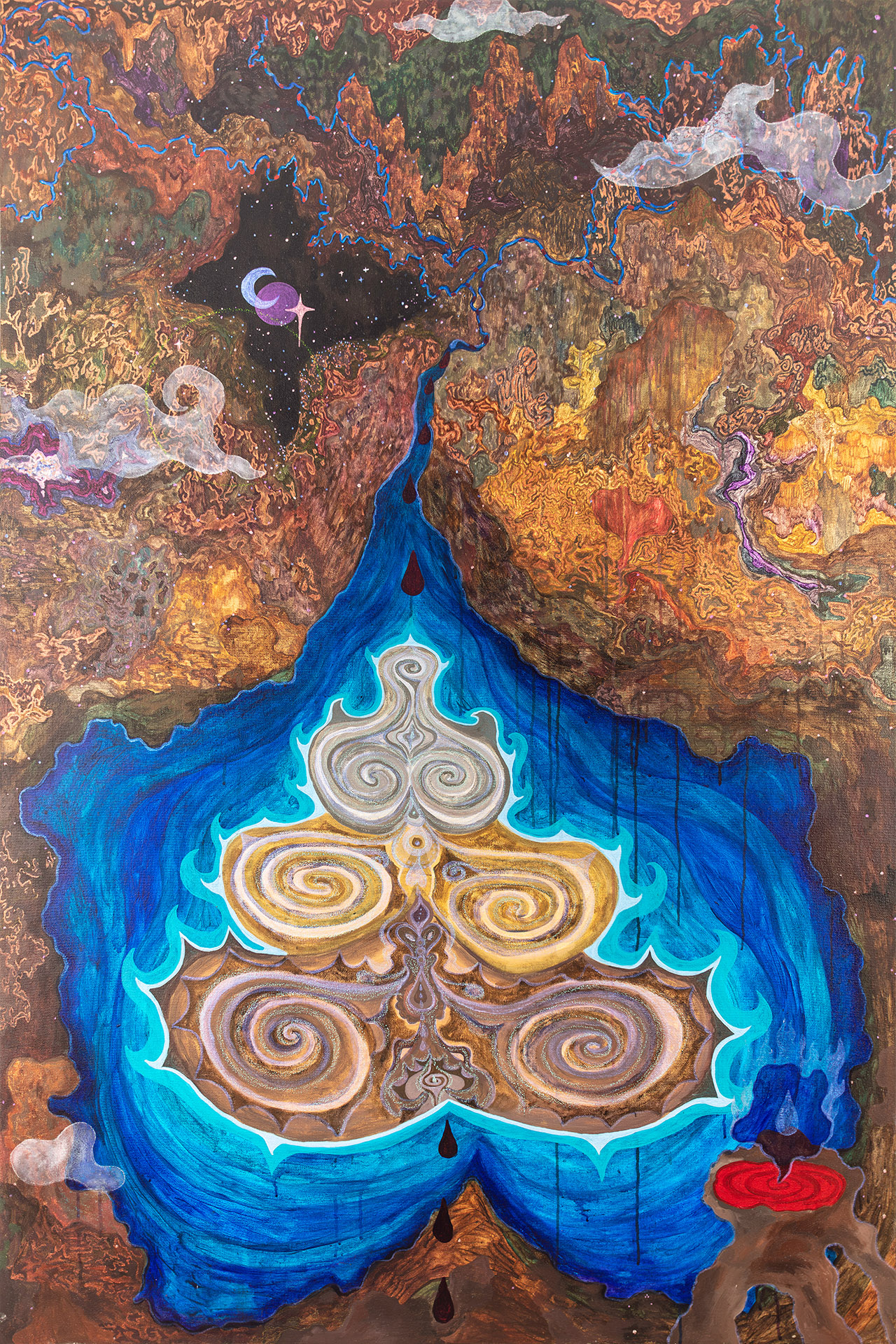
At the same time, she began thinking of water and blood interchangeably. Returning to her longstanding metaphor of the cave, she reimagines it here as her own body: "my womb, a site where water flows and moves," a place where she could "focus and distill the intense energies and emotions of that time."
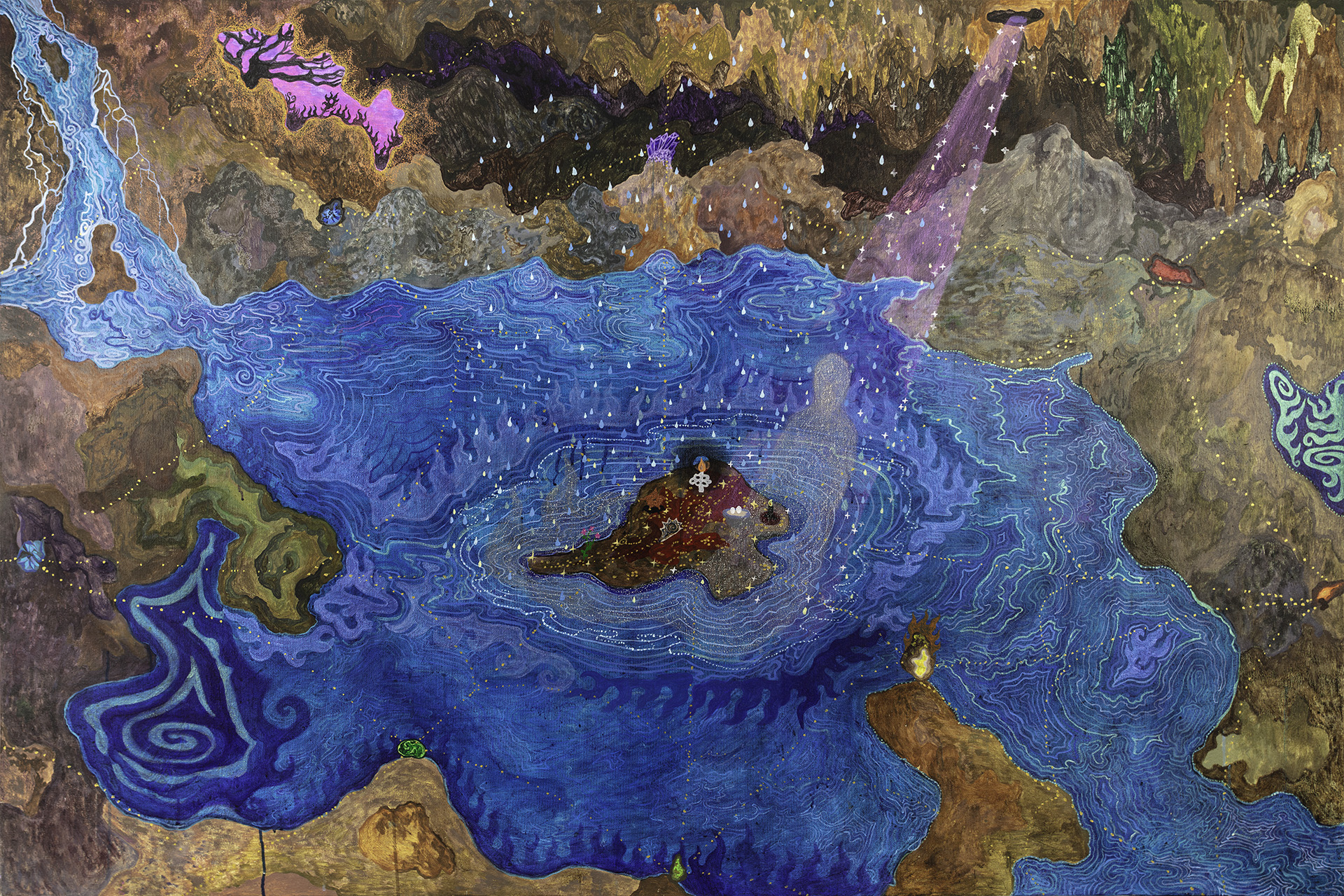
While creating the work, she came to understand that "the more I cultivated this altar inside of me, the more fortressed I became as a person." Golden threads weave throughout the composition, symbolizing "the interconnectedness of our inner worlds and outer worlds," the idea that what is created within the mind and body continues to ripple outward.
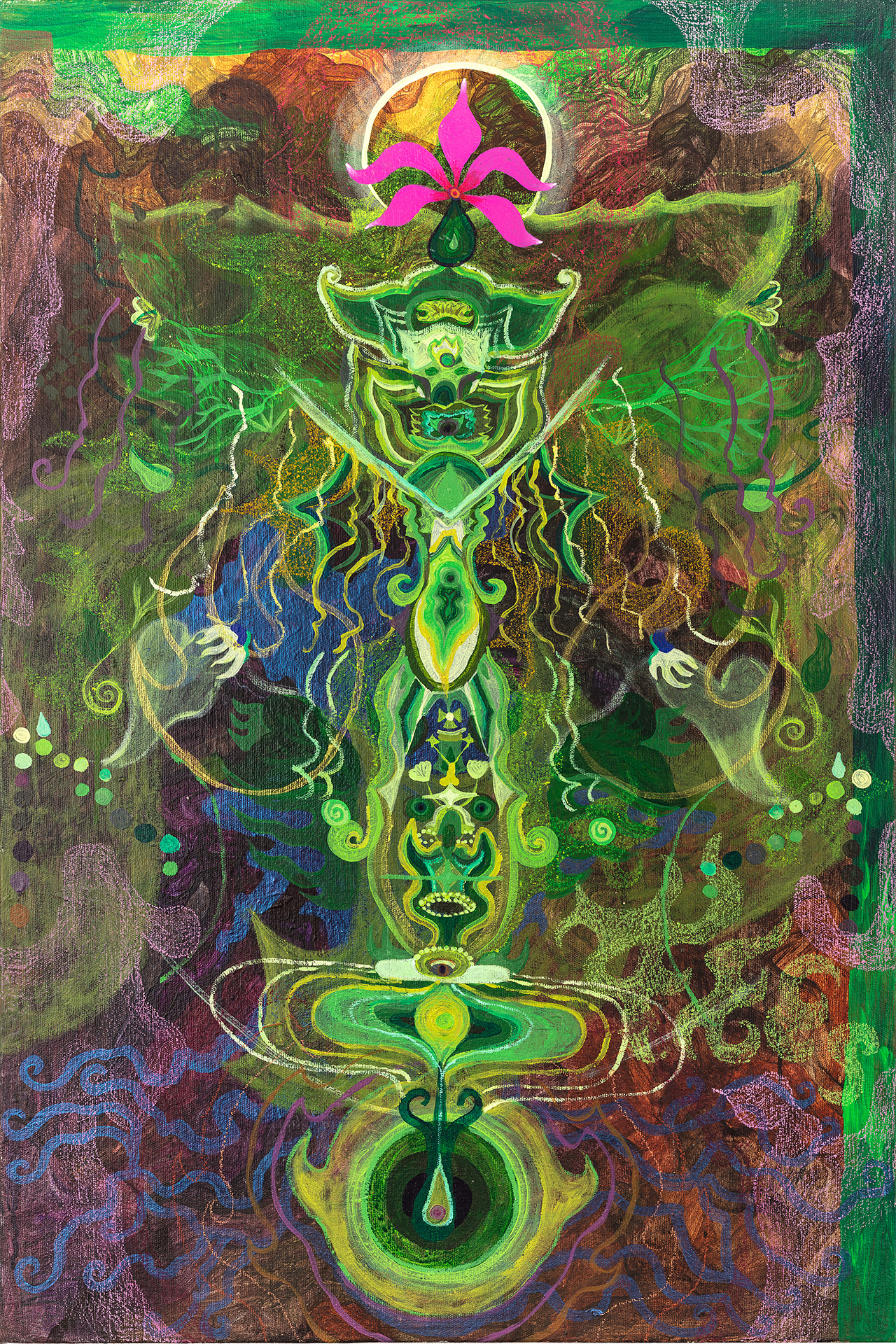
"To connect to the spirit of a plant," she says, "one must see beyond form, one must use another way of seeing." The painting asks what can be known of plants beyond their appearance, inviting viewers to encounter them as "intelligent, mysterious and magical beings."